

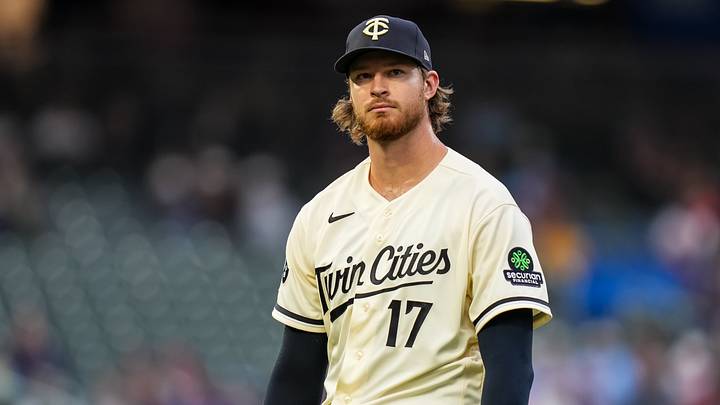
The Minnesota Twins made their first move ahead of the deadline to tender players on Friday, declining to keep Bailey Ober, according to KSTP’s Darren Wolfson. The move puts an end to Ober’s six years with the organization, during which he put together a record of 38-37 and an ERA of 4.15 over 748.2 career innings.
While Ober was a reliable source of innings for the Twins, his velocity had dropped to a point where he was surviving on the mound. Looking at the rest of the rotation, it wasn’t hard to see that Ober became the odd man out and could open things up for a new wave of homegrown starters.
Minnesota Twins move on from Bailey Ober after his fastball velocity sharply declines
Finding homegrown talent on the mound was a challenge for the Derek Falvey era in Minnesota, but Ober was a rare success story. Selected by the Twins in the 12th round of the 2017 draft, Ober made his debut in 2021 and got off to a fast start by going 13-12 with a 3.63 ERA in his first three seasons.
That stretch included an 8-6 mark and a 3.43 ERA over 144.1 innings in 2023 and the following year, he remained solid, going 12-9 with a 3.98 ERA in 178.2 innings. His ability to limit hard contact and walks was also a staple of his success, but those things started to fail as he battled injuries.
The biggest issue was the loss of velocity. While he had plenty of leverage from a 6-foot-9 frame that earned him the nickname “The Bearded Nightmare,” his fastball dropped from an average of 91.7 mph in 2024 to 88.1 mph last season, according to Baseball Savant.
The lack of velocity led to a rash of other problems. Ober’s chase rate went from 33.5 percent in 2024 to 29.9 percent in 2026 and he also missed bats in general, with his whiff rate dropping from 29.0 percent to 20.3 percent.
Long known as a fly-ball pitcher, this became a problem and his overall numbers suffered. In the past two years, Ober was able to throw 277.1 innings, but they were no longer effective, with a 13-16 record and a 4.80 ERA. He also issued a career-high 2.5 walks per nine innings and his strikeout rate dropped to a career-low 17.1 percent.
Bailey Ober’s departure gives the Twins’ young starters a chance to shine
With all of that contributing, Ober is done in Minnesota. But the Twins may have prepared for this day by signing Sonny Gray earlier this week. Even had Ober stayed, there may not have been room for him to be in the rotation with Gray, Joe Ryan, Pablo Lopez, Taj Bradley and Dean Kremer filling out the projected rotation going into Spring Training.
Gray also hinted that the Twins may not be making moves, which could mean that another starter could be joining soon, leaving Ober’s status in further doubt.
With his velocity declining, a move to the bullpen wasn’t an option and the Twins seemed to do all they could do before moving on. The players behind him, such as Zebby Matthews, Mick Abel and Kendrys Rojas also have a shot at earning major league innings, making Ober more of a roadblock than a contributor at this point in his career.
As an innings eater, Ober may still have a market, but his time in Minnesota had run its course, making Friday’s news not all that shocking.
 Add us as a preferred source on Google