

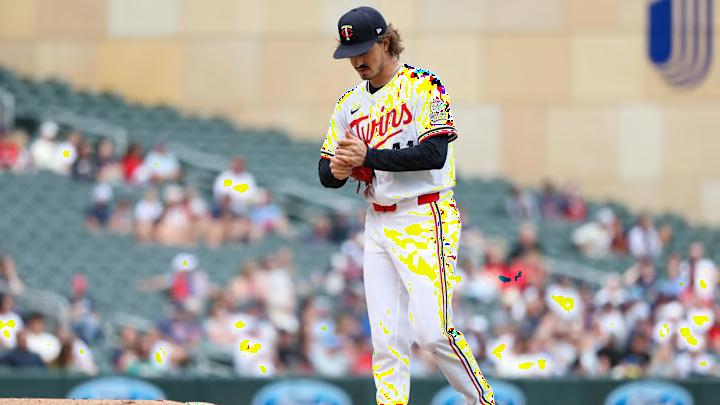
At this point, it doesn’t even feel surprising. Nine pitches into his start on Sunday, Joe Ryan walked off the mound with elbow soreness. A few days earlier, Tarik Skubal—one of the most dominant starters in baseball—went down with an elbow issue that could sideline him for months. Now Ryan, the steady presence at the top of the Minnesota Twins rotation and a potential trade piece at the deadline, is suddenly a question mark. And in Minnesota, it hasn’t even been limited to elbows. Pablo López, arguably the most reliable arm on the staff, suffered a season-ending tear in his UCL in his throwing arm.
And it hasn’t stopped there. Other pieces of the rotation like Mick Abel (right elbow inflammation) have dealt with interruptions of their own, forcing the Twins to adjust on the fly far earlier than expected. That’s usually where the conversation begins—bad luck, unfortunate timing, poor training, another injury in a long season. But it’s getting harder to leave it there, because this isn’t just happening to the Twins. It isn’t isolated, and it isn’t new. It seems to be league-wide.
It's not just one injury, or one team—it’s everywhere
Zoom out, and the pattern becomes difficult to ignore. Over the past few seasons, some of the most dominant starting pitchers in the game have dealt with elbow injuries serious enough to reshape entire seasons or their entire career. For example, Braves starter Spencer Strider went from one of baseball’s most electric strikeout arms to undergoing Tommy John surgery in 2024. In fact, it was his second time undergoing TJ surgery, the first in 2019, when he was still pitching for Clemson University. Since his surgery, Strider has yet to regain his 2023 form that saw him lead the league in strikeouts.
Shane Bieber, a former Cy Young winner, has battled to return to the mound after undergoing TJ surgery in April of 2024. He began the 2026 season on the 60-IL after missing most of 2025 and, after a setback this spring, is still hopeful to return later in May. Like the Twins, the Toronto Blue Jays have sustained their fair share of starting pitching injury woes, with both Max Scherzer and former Twin José Berríos currently sidelined with elbow and forearm injuries.
Padres starter Walker Buehler is still trying to find his footing after two major Tommy John surgeries in 2015 and 2022. Texas ace Jacob deGrom has remained dominant (when healthy) but has been sidelined repeatedly by arm trouble, including a TJ in 2010 and 2023. Even Shohei Ohtani, currently one of the most valuable players in the sport, was shelved as a pitcher in 2024 when he tore his UCL and underwent a procedure to repair it.
These aren’t depth pieces or back-end starters. These are the pitchers teams build around, the ones expected to lead their rotations. Different organizations, different mechanics, different workloads and yet the outcome is the same. At some point, one has to ask just what is going on here?
Ryan injury continues troubling trend for Twins and MLB starters
This concerning injury trend for MLB starters isn’t just elbows, even if that’s where most of the attention goes. In Minnesota, the concern isn’t limited to Ryan, of course. López has dealt with shoulder troubles as well, which reinforces a broader point. The modern starting pitcher isn’t vulnerable in just one spot. The entire arm is under strain. Elbows, shoulders, forearms—it shows up in different ways, but the result is the same. Rotations that are supposed to anchor teams are suddenly unstable, and depth charts are being tested far earlier than expected. That’s what makes this trend more concerning than a spike in any single injury. It isn’t one weak point. It could be the system itself.
There’s an obvious place to look first: pitchers are throwing harder than ever. Velocity continues to climb across the league, and with it has come a shift in approach. Starters aren’t pitching for seven or eight (or even nine) innings per start anymore, nor are they pacing themselves to do so. They’re attacking for five or six at maximum effort, relying on high-velocity fastballs and sharp breaking pitches designed to miss bats. Like it or not, the modern MLB ace isn’t built for endurance like Nolan Ryan or Randy Johnson. They're built for dominance in shorter bursts, but that style of pitching comes with a cost. Every pitch thrown at max effort increases the stress that is placed on each joint and tendon, and over time, that stress accumulates in ways that rest alone may not solve. So, it should surprise no one when reports show that Tommy John surgery is up nearly 30% in the last ten years.
There’s also been a change in what teams are looking for in their starters. It used to be about command—pitchers who could locate, work efficiently, and get through lineups with elite execution and preparation rather than pure gas. Think Greg Maddux or Roy Halladay. That still matters to a certain degree, but it’s not what defines a frontline starter anymore. Now it’s velocity, movement, and swing-and-miss. When every pitch is thrown with that kind of intent, it’s not hard to see how the strain adds up.
What makes this tricky is that teams are already trying to fix it. Pitch counts are watched, starters are pulled earlier and workloads are managed more than they used to be. And yet the injuries aren’t going down—they seem to be increasing. That’s the disconnect. Baseball is doing more to protect pitchers, but they're still losing them. At some point, it raises the difficult question: is it really about workload, or is it how pitchers are throwing now?
For Twins fans, it’s also why this never feels like a league-wide issue in the moment. It feels personal. It feels constant. It feels like it keeps happening here—and not just at the major league level, and it isn't just Twins pitchers. When top prospects start running into similar setbacks, it reinforces the idea that something bigger is going on. Walker Jenkins—one of the most highly regarded prospects in baseball—has already dealt with injuries that have slowed his progression. Emmanuel Rodriguez, another key piece of the organization’s future, has faced a recent setback. These aren’t fringe names or depth pieces. They’re players the Twins are counting on to shape the next core.
So when injuries hit at the top of the rotation and show up again in the pipeline, it stops feeling isolated. It starts to feel like a pattern. That doesn’t mean the Twins are doing something fundamentally different—the broader trends across baseball suggest otherwise—but from a fan’s perspective, it’s easy to see why it feels like it is.
Across baseball, teams are dealing with the same instability and losing the same kind of frontline arms. But when it’s your ace, your most reliable starter, and even the prospects you’re waiting on, it doesn’t feel shared. It feels like yours. That’s what makes this frustrating. It’s not just a Minnesota problem—it just keeps hitting the players who matter most to their teams. The game has more dominant pitchers than ever. It just hasn’t figured out how to keep them on the mound. Which is why Ryan’s exit doesn’t feel like an isolated incident. It feels like the latest example. Until something changes, it unfortunately won’t be the last.
 Add us as a preferred source on Google