

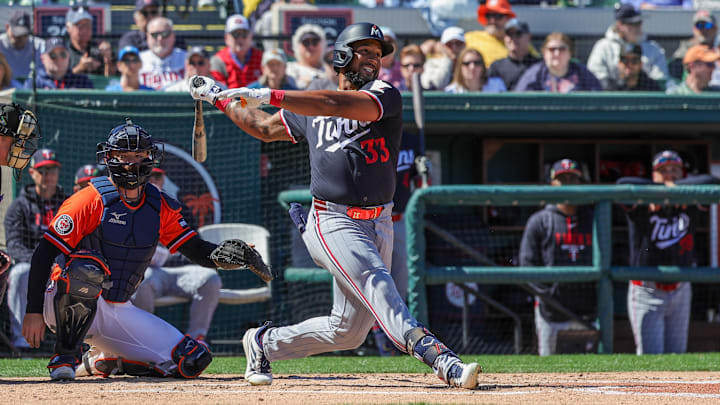
Emmanuel Rodriguez left Friday night’s game after injuring his thumb on a headfirst dive into first base, and while there’s still no official update from the Twins, early indications suggest it may not be a serious issue. That’s encouraging—but it doesn’t change the conversation or consternation this moment created. For the Twins, and for a fan base already watching closely, the uncertainty lands at a very specific moment. Because Rodriguez wasn’t just playing well—he was building a case.
Ranked as the Twins’ No. 4 prospect and a Top 100 talent across MLB, Rodriguez has spent 2026 turning upside into production. He’s hitting .247/.417/.506 at Triple-A with a more aggressive, refined approach, pairing elite on-base ability with real power. That’s no longer projection—that’s performance knocking on the door. And it’s not just the bat forcing the conversation. Rodriguez’s defensive profile has become something the Twins can actually use right now. He can play center field, shift to one of the corners without issue, and he brings enough arm strength to hold down right field long-term. Which brings us to the issues in right field for the big league club.
The Twins don’t just have a prospect—they have a need
At the major league level, right fielder Matt Wallner hasn’t just started slowly—he’s been one of the least productive players in the American League so far this season. Posting a .168/.275/.284 slash line so far, a 56 OPS+, and mounting defensive issues have put pressure on the Twins to consider alternatives to this abysmal showing from Wallner. This isn’t a theoretical roster conversation anymore. It’s a need—which is precisely why the reaction to Rodriguez's injury was immediate.
Per the Twins: Emmanuel Rodriguez was removed from tonight's Triple-A St. Paul game due to a left thumb injury.
— Aaron Gleeman (@AaronGleeman) May 2, 2026
The replies to Aaron Gleeman’s post on X reflected something deeper: a fan base already bracing for what they’ve seen before. They weren’t only asking how bad the injury was—they were already preparing for what it might mean. Another delay. Another reason to wait. Another moment where a ready prospect gets pushed just a little further down the timeline. Fair or not, that perception exists. And this is exactly the kind of situation that reinforces it.
Even if the injury turns out to be minor—and it very well might—that doesn’t automatically mean the timeline picks up where it left off. This is where organizations tend to slow things down. More caution. More runway. More “let’s make sure.” Meanwhile, the need at the major league level doesn’t go away. That’s the issue. Not the injury itself—but what comes after.
Rodriguez had momentum. Real momentum. The kind that forces an organization to make a decision. The Twins weren’t dealing in projection anymore—they had solid production, exactly when the big league roster was showing a clear need in the outfield and Rodriguez was definitely headed in the right direction.
So if this injury truly is minor, the path forward should be simple: get him back on the field, and don’t reset the clock. Because the longer this decision to call up Rodriguez sits post-injury, the more it starts to feel familiar to Twins Territory. With Wallner struggling and Rodriguez knocking on the door, the Twins don’t just have a prospect situation—they have a decision to make. The injury may not be serious, but what the Twins do next is.
 Add us as a preferred source on Google