

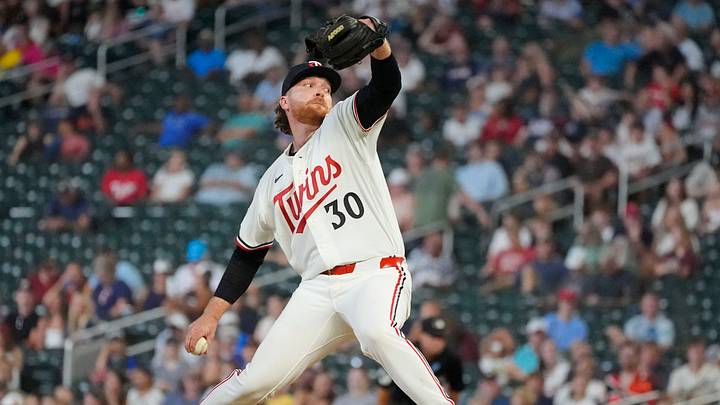
The New York Mets have claimed right-handed reliever Jack Anderson off waivers from the Minnesota Twins, according to MLB.com's Anthony DiComo. The Twins claimed Anderson, 26, off waivers from the Boston Red Sox back in July. He made just four appearances with Minnesota this year. The right-hander made his MLB debut with Boston earlier this year.
In seven career MLB appearances, Anderson has posted a 2.19 ERA and a 1.05 WHIP with 12 strikeouts over 12 1/3 innings. The right-hander recorded a 5.09 ERA over 35 1/3 innings at Triple-A St. Paul this year.
The Twins used Anderson as a depth bullpen arm. After acquiring Anderson, Minnesota immediately optioned him to the Saints. The Twins called him up nine days later, then optioned him back to Triple-A five days later. Sure enough, Anderson was back in the majors two days later, then sent back to St. Paul less than a week after being recalled for the second time. He then spent the remainder of the year in the minors.
The Mets likely view Anderson as a depth piece as well. It's a low-risk pickup for New York, and the club could send him back through waivers if it needs to make room on the 40-man roster.
Why did the Twins cut Jack Anderson?
The Twins likely cut Anderson because the injured list goes away at 4:00 p.m. CDT on Monday and the Rule 5 protection deadline is in roughly two weeks. Cutting Anderson likely cleared needed space on the Twins' 40-man roster.
Hopefully, it's also a sign of bigger moves to come for Minnesota. Anderson isn't a highly regarded reliever by any means, but he is nonetheless a solid depth arm. By getting rid of Anderson, the Twins could be gearing up to add bigger-name players to the 40-man roster.
The Detroit Tigers selected Anderson in the 16th round of the 2021 MLB Draft out of Florida State University. The Red Sox acquired Anderson from the Tigers in the Triple-A phase of the 2024 Rule 5 Draft.
Over his six-year minor-league career, Anderson has recorded a 4.40 ERA with 358 strikeouts over 366 1/3 innings. Anderson relies on five pitches: a low-90s four-seamer (33%), low-80s split-finger (23.3%), mid-80s slider (22.2%), low-80s sweeper (15.6%) and high-70s curveball (5.6%).
During his brief time in the majors, Anderson excelled at limiting walks and hard contact while striking out batters at a 25% rate. The main concern from his brief MLB stint was his poor groundball rate (36.4%). His fastball velocity is also near the bottom of the league (sixth percentile).
 Add us as a preferred source on Google