

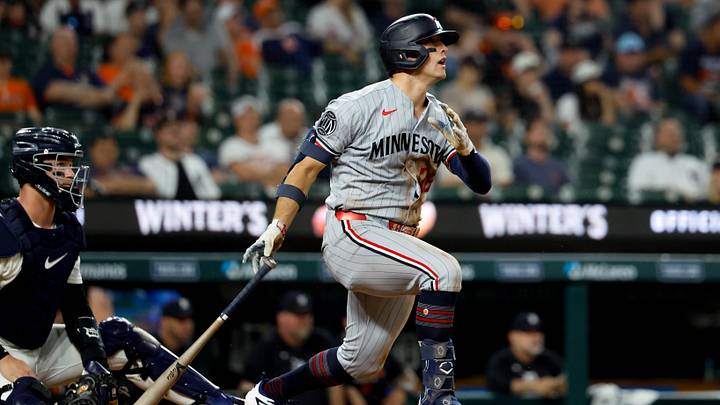
Throughout his professional career, Brooks Lee has mainly profiled as a contact hitter. While his career batting average doesn't reflect that, anyone who watches him hit notices his elite ability to control the zone and frequently make contact. Despite hitting just .240 this season, Lee has outstanding strikeout (15.3%, 82nd percentile) and whiff (20.7%, 69th percentile) rates.
For a hitter with a low 7% walk rate and .240 batting average, one would imagine he is having a below-average season at the plate, especially since he's never been known for his power. However, Lee has a 102 wRC+ because he has surprisingly hit 14 home runs so far this year. Lee's on pace to destroy his personal home run record of 16, which he reached last season with Minnesota and in 2023 in the minors.
Brooks Lee drills a 2-run HR to double Minnesota's lead!
— Just Baseball (@JustBB_Media) June 27, 2026
He's hit 2 home runs in his last 3 games 💪
pic.twitter.com/XqmNI5n9eF
Can Twins' Brooks Lee continue his power surge?
If Lee is going to start hitting 20+ home runs per year, there's a lot to like about his game. However, he doesn't hit the ball particularly hard and has an expected slugging percentage of .337, while his actual slugging percentage is .439. That suggests his power numbers will go down. On the other hand, his squared-up rate this year is 28.6% (78th percentile). For those who don't know, squared-up rate shows us how much of the highest possible exit velocity available a hitter was able to obtain based on the speed of the pitch and swing speed.
The concern with Lee relying on his power for this breakout season is that it has never been the best part of his game. If he is unable to continue hitting homers at a high rate, but his walk rate and batting average stay around the same level, he will become a below-average hitter, just as he was the last two seasons.
One thing that may be easier for Lee to work on to become a more valuable player is his defense. After he posted -7 Defensive Runs Saved and -6 Outs Above Average in 390 innings at shortstop this year, Minnesota moved him to third base. While his numbers at third haven't been nearly as bad as they were at shortstop, they still haven't been good (-3 DRS and -2 OAA in 275 1/3 innings).
It's really difficult to evaluate how the rest of Lee's career will go. He's just 25, so he has plenty of time to improve. There are plenty of reasons to believe he won't pan out long-term, but there is also much to like about how he plays the game. He's been a streaky hitter this year, but he deserves credit for putting up power numbers no one saw coming and happily making the move to third base for the better of the team.
 Add us as a preferred source on Google