

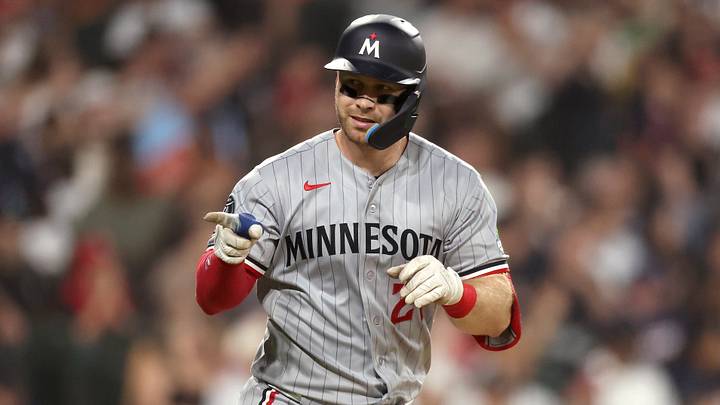
The Minnesota Twins had an important domino fall on Tuesday when ESPN’s Aiden Gonzalez reported that Ryan Jeffers has accepted the team’s qualifying offer. The offer is a one-year contract worth $23.15 million and allows the Twins to keep the 29-year-old through the 2027 season.
Considered one of the top catchers and one of the top available free agents heading into this winter, Jeffers' return is a big win after he had one of the best seasons of his career in 2026. But it also plays out in the best way imaginable for the Twins, who have their backstop in place for next season while also paving the way for Vahn Lackey and some of their other catching prospects to take over in 2028.
Ryan Jeffers accepts Minnesota Twins’ $23.15 million qualifying offer for the 2027 season
Jeffers was one of the biggest catalysts at the plate for the Twins last season. In 92 games, Jeffers hit .256/.353/.461 with 14 homers and 56 RBI. Those numbers would have been even bigger had he not suffered a hamate fracture in his left hand in May, and his solid defensive work behind the plate made him an intriguing target for teams that needed a catcher.
This is why Jeffers was involved in several trade rumors before the deadline in August. It’s also why many expected Jeffers to sign a contract elsewhere after his comments during the final series of the season in September.
“I think when you spend seven years in an organization, or I guess eight years including the MInors, you don’t want that chapter to end,” Jeffers said via MLB.com’s Matthew Leach. “I’ve worked too hard to corner myself into…one team or two teams. I love the idea of a reunion. I also love the idea of going out there and seeing what else is out there. I’m excited for this. I’ve worked really hard for this moment, for free agency, and that doesn’t mean the chapter here has closed. We’ll just see where we go.”
While Jeffers expressed excitement in seeing what was out there, FanGraphs’s projection had him getting a three-year, $48 million contract with an average annual value of $16 million on a three-year contract. MLB Trade Rumors also had a high-end projection of a four-year, $75 million deal that would have netted him $18.75 million per season.
Those deals would have given Jeffers long-term security. But he may have preferred the one-year deal and guaranteed $23.15 million in the qualifying offer instead. It also may have been tougher to get the projected deals as teams would have had to give up draft pick compensation to acquire Jeffers, and that has led him back to Minnesota.
Ryan Jeffers’s return helps Twins avoid rushing Vahn Lackey to the majors
With Jeffers back in the fold, the biggest question is what happens next. Twins owner Tom Pohlad told reporters after the season that the team would increase its payroll in 2027, but he declined to put a number on it. The qualifying offer also represents a significant chunk of salary, which president of baseball operations and general manager Jeremy Zoll said the team was prepared for during last week’s GM meetings in Las Vegas.
“From a planning perspective, we have to plan for it and if he accepts,” Zoll said via The Athletic’s Dan Hayes. “We still have other ways we’re going to want to build out the team and make it the best team we can.”
For this year’s team, having Jeffers is a significant piece of the puzzle. Jeffers can remain in his starting role and pair with Victor Caratini behind the plate. But the Twins can also take time with their development of some of their catching prospects in the system.
The headliner of that group is Lackey, whom the Twins took with the third overall pick in last June’s draft. While Lackey has the talent to fast-track through the organization, he played just 25 professional games last summer and may need some additional time to develop before reaching the Major Leagues.
Eduardo Tait, Khadim Diaw and 2026 second-round pick Carson Tinney are also top 10 prospects in the organization according to MLB Pipeline, but Diaw is the only prospect among that group that has an estimated call-up of 2027. Had Jeffers left, the Twins would have needed to find a stopgap to call these players to the majors before they were ready.
With a one-year investment, the Twins can also cut bait at the end of the season to give Lackey the job. Or they can do what they failed to do at last year’s deadline by trading Jeffers for a return after June 15.
Regardless, Jeffers’s return, albeit surprising, has more positives than negatives and it allows the Twins to answer one big question ahead of next season.
 Add us as a preferred source on Google