

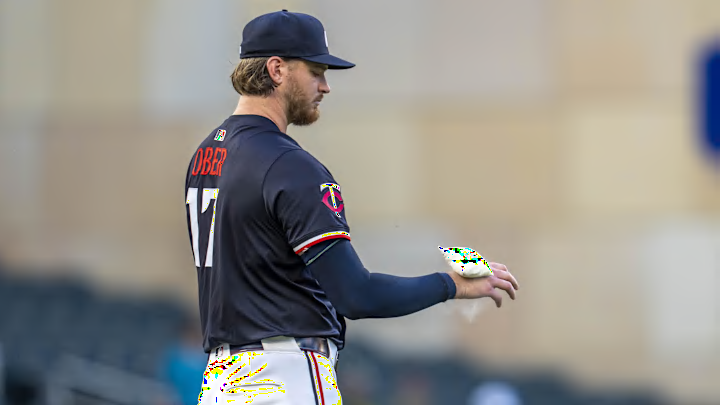
The concern wasn't whether Bailey Ober's velocity would dip during spring training—it was whether it would continue once the regular season games started. Now, there's at least a partial answer.
Ober's fastball is still sitting in the high-80s as of his first start of 2026 on Sunday. The swing-and-miss hasn't followed. And the overall look—more contact, less margin—feels familiar in a way that's hard to ignore. That point was driven home even more clearly in a post from Aaron Gleeman, who noted that Ober generated just two swing-and-misses on 56 pitches in his first outing. That's not just a small dip—it's a red flag.
Bailey Ober's fastball averaged just 89.8 mph and he gave up a three-run homer on an 88.8 mph sinker.
— Aaron Gleeman (@AaronGleeman) March 29, 2026
Ober struck out just one of the 17 batters he faced and got only two swing-and-misses on 56 total pitches, both with changeups.
Last week, a Puckett's Pond piece raised the possibility that the Twins might eventually need to look outside the organization if this trend continued. At the time, it was a reasonable projection based on spring data. After Ober's first outing, it feels less like projection and more like direction.
How much time do the Twins really have to wait on Bailey Ober?
For most pitchers, sitting 89–90 mph wouldn’t stand out. For Ober, it does. His success has never been built on overpowering hitters. It’s been built on precision—extension, command, and a fastball that plays above its velocity. But that formula only works within a certain range. At 92 mph, it’s effective. At 89, it starts to thin out. Hitters don’t have to commit as early. The separation between pitches tightens. And when that happens, even well-located fastballs don’t carry the same weight.
This is where this becomes more than a story about pure velocity. It's not just that the fastball is slower—Ober's pitches are falling flat as well. Reduced velocity also means reduced movement, and for a pitcher like Ober, that matters. When the fastball loses life, and the sinker doesn't sink, the margin disappears quickly. The strikeouts haven't been there. The swing-and-miss hasn't returned. And when you're getting two whiffs on 56 pitches, hitters aren't just making contact—they're comfortable. That showed up in a big way on the three-run home run Ober surrendered to Tyler O'Neill—a sinker left up that didn't move, driven out at 109 mph.
So, what do the Twins do about this? Here is where the timeline comes into play. This isn’t a one-start decision. The Twins don’t have the depth or the flexibility to react immediately, especially with a rotation that’s already taken some hits. Ober is still one of the more established and experienced arms they have available, and that matters. But so does the trend.
Realistically, this is probably a 2–4 start window, maybe stretching a little further if he can keep games manageable. Beyond that, it becomes harder to justify waiting for a version of Ober that hasn’t shown up yet. At this point, it’s not just a slow ramp-up—it’s a continuation.
The other part of this conversation is that the Twins may not need to look very far for alternatives. Zebby Matthews is the most straightforward option. He’s already been through this cycle before, and he can give them innings. If the goal is to stabilize the rotation, he makes sense. But that’s also the limitation. Matthews likely gives you something similar—not necessarily something better. If the Twins are looking to change the shape of the rotation rather than cover innings, the more interesting name is Connor Prielipp.
Prielipp brings a different kind of profile—more swing-and-miss, more upside, and a left-handed look that contrasts with what Ober offers. But that comes with less experience, more volatility, and an injury history that still lingers in the background. Calling him up wouldn’t be a safe move. It would be a directional one. That’s really what this comes down to. The Twins don’t just have replacement options—they have a decision to make about what kind of solution they want.
They don’t need to act today, but they also can’t ignore what they’re seeing. This isn’t just about one outing or one number on a radar gun. It’s about whether the version of Bailey Ober they’re getting right now can still hold together over a full stretch of starts. If it can’t, the answer might not be out on the market. It might already be waiting in St. Paul.
…though, as my colleague suggested last week, it wouldn’t be the most shocking thing if the Twins at least kept tabs on someone like Lucas Giolito. Just in case.
 Add us as a preferred source on Google