

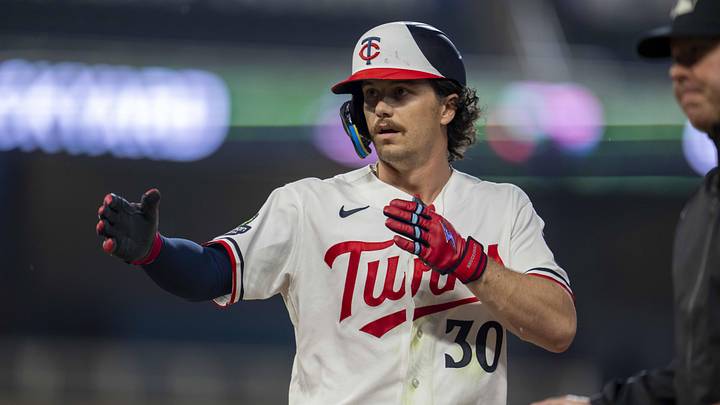
The Minnesota Twins pulled the trigger on a highly anticipated roster move by designating outfielder James Outman for assignment (DFA). Acquired from the Los Angeles Dodgers last summer in exchange for reliever Brock Stewart, Outman was a classic change-of-scenery gamble. The front office hoped the left-handed hitter could rediscover the impressive form that earned him a third-place finish in the 2023 National League Rookie of the Year voting.
Unfortunately, the experiment yielded entirely different results. Outman’s biggest flaw has always been a high strikeout rate, and those swing-and-miss issues intensified in Minnesota. After struggling significantly upon his arrival last season, his 2026 campaign failed to gain any traction. Slashing just .156/.229/.250 across 70 major league plate appearances this year, his playing time evaporated by late May. Coupled with defensive metrics that took a downward turn, the Twins simply could no longer afford to carry him on the 26-man roster, choosing instead to risk losing him on waivers or outrighting him to Triple-A St. Paul.
How Outman's DFA alters the Twins' outfield picture
1. The Immediate Floor: The Platoon & Bench Dynamics
Outman's role this season had dwindled to late-game defensive subbing and situational pinch-running. Removing him means Minnesota is letting go of a pure defensive safety net in center field.
- With Byron Buxton dealing with ongoing shoulder maintenance, center field duties fall completely into a streamlined mix.
- It elevates the everyday stability of players who offer more consistent underlying contact traits, eliminating a "dead spot" on the bench when a pinch-hitter is desperately needed late in ballgames.
2. Fast-Tracking the Next Wave (Jenkins & Rodriguez)
This is the most significant macro ripple. Keeping Outman on the 40-man roster was a bet that he could solidify himself as a cost-controlled, long-term fixture in the grass. His departure officially sounds the alarm that the "interim" era is winding down.
- High-upside prospects like Walker Jenkins and Emmanuel Rodriguez see their paths to Target Field become dramatically clearer.
- By moving on from the Outman experiment now, the front office signaled they are preparing the runway for these elite organizational building blocks, rather than letting a high-whiff veteran block the transition.
Ultimately, trading for Outman was a calculated flier on an athletic profile that fit the modern organizational philosophy. Moving on from him proves the front office won't fall victim to the sunk cost fallacy. It forces the club to lean fully into its proven internal assets while aggressively preparing the soil for their next generation of outfield prospects.
 Add us as a preferred source on Google