

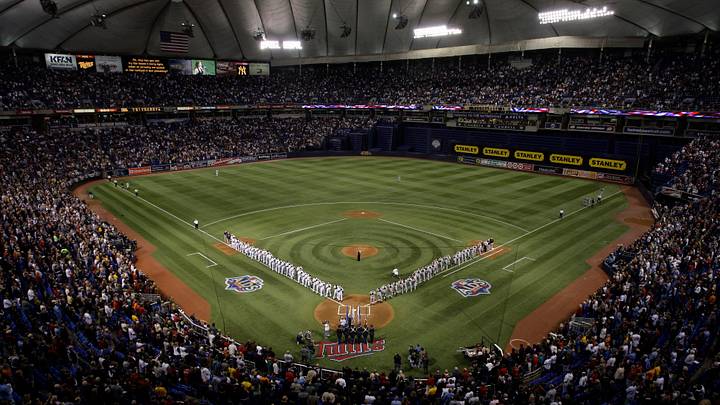
The 2026 World Series is guaranteed to produce a first-time champion. Neither the Tampa Bay Rays nor the Milwaukee Brewers has ever won baseball's biggest prize, and both call ballparks with roofs home. Depending on the weather in Milwaukee, we could even see the first World Series played entirely indoors.
For longtime Twins fans, this is sure to bring back some familiar memories. The Metrodome was notorious for its unusual playing conditions, and Minnesota's two championship runs in 1987 and 1991 helped cement its reputation as one of baseball's strangest home-field advantages. If this postseason has taught us anything, it's that a roof can still cause plenty of trouble.
When the Roof Becomes Part of the Game
The roof has already made its presence felt twice during the 2026 postseason, and neither incident was particularly welcome for the visiting team.
During Game 1 of the National League Division Series, San Diego's Ty France launched a ball toward left field at Milwaukee's American Family Field. With the Padres trailing by one run in the ninth inning, the blast appeared to have a chance to give San Diego the lead. Instead, the ball struck a cable attached to the closed roof and dropped into the glove of Brewers left fielder Jackson Chourio for an out. Just two days later, the roof got involved again.
In Game 2 of the American League Division Series, Yankees outfielder Spencer Jones sent a towering popup into the catwalks at Tropicana Field. The ball struck the B-ring high above the field, leaving Tampa Bay's defenders waiting nearly ten seconds for it to come down. Victor Mesa Jr. eventually made the catch. Both plays were ruled outs under their respective ballparks' ground rules. For anyone who remembers baseball at the Metrodome, it all sounds awfully familiar.
The Twins Introduced the World Series to Indoor Baseball
On October 17, 1987, the Minnesota Twins and St. Louis Cardinals made baseball history when Game 1 of the World Series became the first Fall Classic game ever played indoors. The Astrodome had been hosting Major League Baseball games since 1965, but no domed stadium had hosted a World Series game until the Metrodome.
The Cardinals were hardly strangers to October baseball. They had already won nine World Series championships and had reached the Fall Classic three times in six seasons. But the Metrodome presented an entirely different challenge. Between the artificial turf and more than 55,000 screaming fans waving Homer Hankies, visiting teams had plenty to contend with. The roof itself was the most troublesome feature for road teams. Its color would swallow up fly balls during daytime games and the lighting would create blind spots for outfielders. It was a true tenth man on the field.
Minnesota went 56–25 at home during the 1987 regular season, compared with a miserable 29–52 road record. The Metrodome wasn't just where the Twins played. It was where they were at their best. When the World Series arrived, Minnesota took full advantage. The Twins opened the series with a 10–1 win, won Game 2 8–4, and returned home after three losses in St. Louis to win Games 6 and 7. For the first time in World Series history, the home team had won every game. Minnesota had its first World Series championship since the franchise relocated from Washington, and the Metrodome had earned a permanent place in baseball history.
When Baseballs Actually Hit the Metrodome Roof
Of course, the Metrodome's reputation wasn't limited to fly balls disappearing against the ceiling. Sometimes, baseballs actually hit it. And occasionally, they didn't come back down.
In May 1984, Oakland Athletics slugger Dave Kingman hit a towering popup that disappeared into a drainage hole in the Metrodome roof. The players waited for the ball to return, but it never did. With no specific rule addressing the situation, the umpires eventually awarded Kingman a ground-rule double.
The roof continued causing trouble throughout the stadium's history. In 1992, Detroit's Rob Deer hit the ceiling in consecutive at-bats. Both balls came back down and were caught by Twins shortstop Greg Gagne for outs. That same year, Minnesota's Chili Davis lost a potential home run when his drive struck a suspended speaker and bounced back onto the field, where it was caught. At the time, balls striking the roof or suspended equipment could remain in play, creating some genuinely unusual outcomes. The Metrodome's ground rules were eventually changed in 2005. Sound familiar?
The rules at Tropicana Field and American Family Field aren't identical to those of the old Metrodome, but the principle remains the same: sometimes the architecture gets involved. When it does, the result can be the difference between a hit and an out.
The Metrodome Works Its Magic Again in 1991
Four years after their first Minnesota championship, the Twins returned to the World Series against the Atlanta Braves. Once again, the Metrodome proved to be a difficult place for visitors.
The 1991 World Series became one of the greatest in baseball history, featuring five one-run games, extra-inning drama, Kirby Puckett's legendary Game 6 home run (with an equally legendary call by John Gordon), and Jack Morris's unforgettable ten-inning shutout in Game 7. The Braves experienced their share of frustration with the Dome, too. During Game 6, Atlanta left fielder Brian Hunter lost a Kent Hrbek popup against the roof, another reminder that even a routine play could become troublesome indoors. But the Metrodome's greatest contribution may have been its atmosphere.
With the Homer Hankies waving and the noise reaching astonishing levels (reaching 105 dB in 1991, 125 in 1987), Minnesota had an environment unlike anything else in baseball. The Twins knew how to play there, and their fans made certain the visitors knew whose house it was. When Gene Larkin singled home Dan Gladden in the bottom of the tenth inning of Game 7, Minnesota claimed its second World Series title in five seasons. The Twins had now played eight World Series games at the Metrodome. They had won all eight. It's difficult to imagine a better home-field record than that.
Could the 2026 World Series Make Indoor Baseball History Again?
The Brewers and Rays enter this year's World Series with something neither franchise has experienced before: bringing home a championship.
Tampa Bay plays under a permanent roof at Tropicana Field, while Milwaukee can open or close the retractable roof at American Family Field, subject to MLB's postseason rules. With late-October temperatures in Milwaukee expected to cool considerably, there's a real possibility the roof will remain closed throughout the series. If that happens, the 2026 World Series would become the first played entirely indoors. And after the unusual plays we've already witnessed this postseason, it's worth wondering whether either roof has another surprise waiting.
Nearly four decades have passed since the Twins introduced the World Series to indoor baseball. The Metrodome is gone, replaced by the open skies of Target Field, but its peculiarities remain part of Minnesota's baseball history. The Rays and Brewers will write their own championship story this October. One of them will celebrate a franchise first, and fans will have memories that last a lifetime. Twins fans know that feeling well.
They also know that, when it comes to October baseball, sometimes even the roof has a role to play.
 Add us as a preferred source on Google