

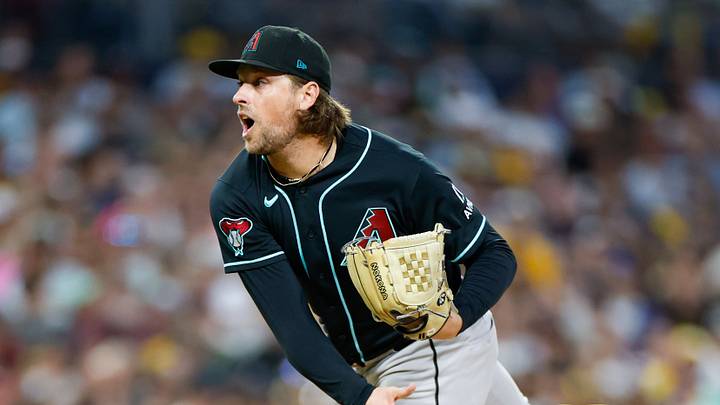
The Twins brass gave Minnesota fans one more thing to be thankful for on Thanksgiving Eve by agreeing to a two-year, $18 million contract with right-handed reliever Kevin Ginkel, according to MLB.com's Mark Feinsand. It's a surprising move, as The Athletic's Dan Hayes reported earlier in the week that a left-handed reliever is one of the top items on the team's to-do list. The Twins could still add a left-handed reliever, but it's doubtful it will be a big-name arm after they committed a whopping $18 million to Ginkel.
This past season, Ginkel posted a 4.12 ERA over 67 2/3 innings. He had a 7.36 ERA over 25 2/3 innings in an injury-affected 2025 season. While $18 million seems like a lot for the Twins to commit to Ginkel based on those numbers, a deeper dive into his underlying metrics shows Minnesota made a smart move in bringing in the right-hander.
New Twins reliever Kevin Ginkel is much better than his 2026 results
Ginkel's Baseball Savant page shows much more red than blue, which, if you're not aware, is good. In 2026, the right-hander had a 26.2% strikeout rate (77th percentile), a 6.2% walk rate (88th percentile), a 3.55 expected ERA (74th percentile) and a .227 expected batting average (69th percentile).
The main concern with Ginkel is that he gave up a lot of hard contact last season, with an 89.5 mph average exit velocity (26th percentile) and a 39.5% hard-hit rate (38th percentile). Still, his strikeout and walk rates indicate that he pitched much better than his 4.12 ERA showed.
Ginkel, 32, brings the heat with a four-seamer that sits at 95.7 mph. He pairs his heater with a mid-80s slider that opposing batters hit just .168 off of in 2026. His four-seamer has unfortunately been hit hard throughout his career, which is why he throws his slider more. Still, the high velocity on his heater makes it an effective pitch when used right. The right-hander also occasionally mixes in a mid-90s sinker.
Ginkel has eight years of big-league experience, all with the Diamondbacks. He has a career 3.91 ERA and 3.46 FIP with 355 strikeouts over 326 2/3 innings. He is also battle-tested, hurling 11 2/3 scoreless innings while striking out 15 during the 2023 postseason as Arizona won the National League Pennant.
The Twins already committed significant money to right-handed starting pitcher Sonny Gray ($55 million for two years) and catcher Ryan Jeffers ($23.15 million for one year) this offseason before signing Ginkel. After the season ended, Tom Pohlad said he would give the front office the financial resources it needs to compete next year. He has certainly put his money where his mouth is.
The Twins aren't done spending yet, either, as Hayes' recent report also said they're seeking a first baseman or second baseman. There's a good chance the Twins will also add another reliever or two, but probably not one as expensive as Ginkel.
The Twins had one of the worst bullpens in baseball last year, ranking No. 26 in ERA. With the addition of Ginkel, the bullpen is already in a much better spot than it was last offseason. Additionally, midseason acquisitions Jeff Hoffman, Yoendrys Gomez and Tommy Nance will return next year. Acquiring Bobby Miller from the Los Angeles Dodgers in the Royce Lewis trade should also improve the bullpen. Additionally, the Gray signing could also allow a starter to convert to a reliever. Long story short, Minnesota's bullpen should be much better in 2027.
 Add us as a preferred source on Google