

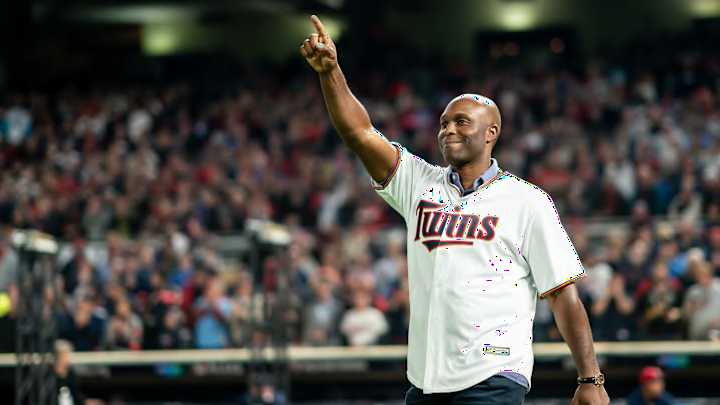
The Hall of Fame conversation around Torii Hunter has always been a trifle complicated: he checks many of the traditional boxes voters claim to value, yet his vote totals have remained modest since hitting the ballot. That combination makes him one of the more interesting "borderline" candidates of his era. Now, with Andruw Jones set to be enshrined later this year, Hunter's name has been floated again regarding the HoF. To understand whether he can make a late run, it helps to break his case into three parts - his career résumé, how his profile compares to Cooperstown center fielders, and what his voting trends suggest about the road ahead.
Twins legend Torii Hunter’s HoF Case: Defense, Longevity, and the Voting Reality
The Résumé
Hunter's Cooperstown argument begins with the kind of foundation voters have historically respected: a long career in a premium position, standout defense, and enough offense to avoid being labeled a "glove-only" specialist. Hunter's career totals include:
2,452 hits
353 home runs
1,391 RBI
195 SB
9 Gold Gloves
5 All-Star selections
Career WAR: 50.6
Those numbers matter because they show Hunter wasn’t a short-burst star. Over a 19-year career, he stayed relevant at center field - one of the most demanding everyday jobs in baseball - and combined highlight-level defense with legitimate power and run production. His best seasons weren't confined to a brief peak, and his impact wasn't limited to just the batter's box. He was a complete player whose calling card was excellence in the field, backed by consistent offensive production over his long career. It also bears pointing out that a center fielder who hits 350+ home runs while playing elite defense is NOT a common occurrence in MLB history.
And while the Hall of Fame has no official statistical “minimums,” BBWAA voters have historically used certain career benchmarks as criteria for Cooperstown consideration. Hunter clears several of those "traditional" markers: 2,000+ hits (2,452), 350+ home runs (353), and 1,000+ RBI (1,391). On their own, those totals don’t guarantee a plaque - he isn’t in the 3,000-hit or 500-homer club - but combined with nine Gold Gloves in center field, they strengthen the argument that Hunter wasn’t just memorable, he was productive for a long time at one of the game’s toughest positions.
A note on WAR: yes, in modern evaluations, Wins Above Replacement is often weighed alongside traditional stats in Hall of Fame voting. The average Hall of Famer falls into the 50-70 WAR range - a clear reason Hunter’s overall value keeps him in the conversation even if he isn’t a statistical lock. But WAR has never been the only way into Cooperstown. Lou Brock made it in with a WAR of 45.3, and stealing over 900 bases certainly helped his case. Harold Baines was enshrined with a WAR of 38.8 while still producing over 1,600 career RBI. The point is not that WAR is meaningless - it matters - but baseball history shows that longevity, reputation, and the full context of a career have always played a role in Hall of Fame voting. For a defense-first center fielder like Hunter, that context may be just as important as any single number.
The Comparisons
Torii Hunter’s case exists on a very particular route to the Hall of Fame: the two-way center fielder whose value comes from elite defense, longevity, and steady production - not a short peak of overwhelming offensive dominance. That makes him a tricky comparison, because the Hall’s center fielders tend to fall into two broad groups: the obvious superstars, and the “complete players” whose reputations were built on doing everything well for a long time.
Let's be clear and realistic about this: Hunter is not Ken Griffey Jr. or Willie Mays, but his candidacy shouldn't need that kind of comparison to be considered credible. The better question is whether he belongs among center fielders defined by defense, durability, and all-around impact who are in Cooperstown.
A solid modern parallel for Hunter is Andruw Jones. Jones’s recent election matters for Hunter because it shows that center field defense can still be a key to unlocking the HoF when paired with career-long consistency and relevance. While Jones’ overall statistical case is stronger in some ways, the shape of the argument - premium defense in center, sustained excellence, and a reputation that held up over time - is familiar. For those who are curious, this post from a baseball fan on X in 2024 compares how the two center fielders line up against each other. Spoiler alert: it makes you realize just how underrated Hunter may be in the Hall of Fame conversation...and just how widely appreciated he truly is by baseball fans sport-wide.
I was about to come argue about Andruw Jones being superior with the bat, but then I compared Jones vs Hunter and was quite shocked. Torii with a very under-appreciated career. pic.twitter.com/esTapq0lVe
— Matt (@obe459) December 25, 2024
Hunter also fits the mold of defense-first Hall of Famers like Ozzie Smith and Brooks Robinson - not because they played the same position, but because their Hall cases were built on a simple premise: defense wasn’t a supporting detail, it was the main event. Hunter’s nine Gold Gloves make that framing possible.
If you want to stick strictly to a center field comparison, Hunter’s strongest pitch is that he resembles the “complete career” types more than the “peak dominance” types. That’s where his stats matter. He wasn’t just a highlight reel - he produced 2,452 hits and 353 home runs over a long career. The totals may not compare to Griffey or the "Say Hey Kid," but they should keep him from being dismissed as a glove-only candidate...just like Jones.
The most realistic take here is that Hunter’s case is strongest when compared to Hall players whose enshrinement reflects legacy, defense, and career value, not just offensive dominance. Jones’ election is a reminder that voters can still reward that kind of profile, even if it takes time.
The Outlook: Voting Trends and Time Remaining
If Hunter is going to make Cooperstown, this is the section that matters most. What do the voting trends show us? How much time does he have left? Hunter is listed as a 6th-year candidate on the 2026 BBWAA ballot. Under modern Hall rules, a player can remain on the writers’ ballot for up to 10 years, as long as he stays above the 5% minimum needed to remain eligible. That gives Hunter four more BBWAA elections (2027–2030) to build support.
The challenge is that his vote totals have stayed modest, even if he remains in the conversation:
2024: 7.3%
2025: 5.1%
2026: 8.7%
The 2026 bump is encouraging, but it’s not yet a true breakout. Hunter is still in single digits, and that typically means a steep climb ahead. Most eventual BBWAA Hall of Famers show clearer upward momentum by this point. Still, Jones offers a reason for cautious optimism. Jones debuted with 7.3% of the vote in 2018 and climbed year after year until he reached election in 2026 in his ninth year on the ballot. Hunter doesn’t need to mirror that exact path, but he does need the trend line to start moving in that direction soon.
Even if Hunter doesn’t break through with the writers, that does not mean his Hall of Fame story ends there. Cooperstown history is full of players who fell short on the BBWAA ballot but were eventually recognized through committee voting later on. For Twins fans, Tony Oliva is the clearest example - widely viewed in Minnesota as a player who waited far too long for the honor before finally being elected by the committee. Hunter could realistically follow a similar path: not a fast, headline-grabbing rise, but a long-term case built on legacy, position value, and the kind of defensive impact that remains hard to ignore.
Former Twins Star Torii Hunter's Hall of Fame prospects after Andruw Jones election
Torii Hunter’s Hall of Fame path is a tricky one, but an open one as well. It isn't built on overwhelming offensive dominance, but it is built on something the Hall has rewarded in the past: sustained excellence at a premium fielding position. His career résumé checks many important boxes like elite defense, longevity, and enough offensive production to stand as more than a glove-only candidate. The comparison to Andruw Jones doesn’t prove Hunter will follow the same path, but it does reinforce that center field defense and long-term impact can still win over voters.
The challenge is the clock. Hunter’s vote totals remain modest for a sixth-year candidate, and that means he will need more than steady survival - he’ll need a real surge soon to turn his candidacy into a serious push. Still, the fact that his case remains alive and that the conversation around defense continues to evolve leaves room for cautious optimism. Hunter’s road to Cooperstown is narrow, but it isn’t closed - and if his support starts trending upward over the next few ballots, he has just enough time left to make it interesting.
 Add us as a preferred source on Google