

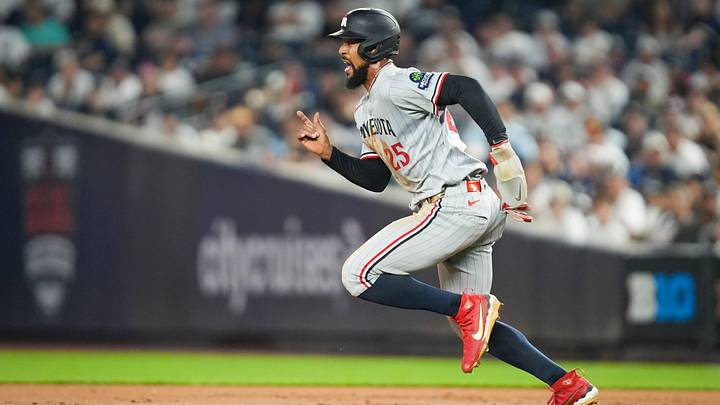
For years, the Twins have managed Byron Buxton differently than almost everyone else on the roster. They've given him scheduled days off, eased him back from injuries, and even shifted him to designated hitter in 2023 in an effort to keep one of baseball's most talented players on the field. That's why his caught-stealing Sunday left me scratching my head.
Byron Buxton left today's game with a re-aggravation of a prior hip injury after this slide into second base. pic.twitter.com/2lTZjzO1AO
— Foul Territory (@FoulTerritoryTV) July 5, 2026
To be clear, this isn't about the baseball strategy itself. With runners on first and third and a full count, sending the runner is common practice. If the batter strikes out, the catcher has to throw to second to complete the out, creating an opportunity for the runner on third to score. There's nothing unusual about the play, but baseball strategy isn't one-size-fits-all. The runner wasn't just anyone. It was Byron Buxton, just a few days removed from another hip issue and arguably the position player the Twins can least afford to lose.
We don't know whether the decision came from the dugout or whether Buxton took off on his own. Players like him are often trusted to read pitchers and make those decisions on the fly. Unless someone inside the clubhouse addresses it, assigning blame would be unfair. Still, the reaction from Twins fans was immediate.
Twins just need Buxton's bat in the lineup. I don't know why we're messing around with having him steal bases when he's a couple days back from yet another hip flare.
— Nick Nelson (@NickNelsonMN) July 5, 2026
Fans are right to question decision for Buxton to steal
Social media quickly filled with the same question: Why?
The frustration wasn't directed at Buxton's hustle. No one has ever questioned his effort. In many ways, it's both his greatest strength and his greatest vulnerability. He plays every inning at full speed, whether it's chasing a fly ball into the gap, crashing into outfield walls, or taking an extra base. At some point, though, even the game's most fearless players have to acknowledge reality. That reality is this: Buxton is now a 32-year-old veteran with a lengthy injury history. The Twins have acknowledged that for years by managing his workload differently than everyone else. Shouldn't that philosophy extend to the bases—especially after he had just missed several games with another hip issue?
I want to be clear—I'm not suggesting that Buxton should stop stealing bases. His speed is one of his greatest weapons, and there will be moments when the reward outweighs the risk. I'm just not convinced that Sunday was one of those times. It wasn't late in a one-run game in September, and it wasn't the tying run trying to get into scoring position in extra innings. It was the first inning in early July. The potential reward was advancing 90 feet. The potential cost was losing Byron Buxton, and for at least one afternoon, that's exactly what happened.
When a player with Buxton's history leaves another game after an aggressive play, it's only natural for fans to question whether the risk was necessary in the first place. Maybe Buxton took off on his own. Maybe the Twins gave him the green light. It's entirely possible that question never gets answered. But regardless of who made the decision, the larger question remains: Was the potential reward worth the risk? I'm not convinced it was.
To Buxton's credit, he downplayed the severity afterward and said he left because he didn't want to turn a one-game issue into something that would sideline him for a month. Hopefully, that's exactly what this proves to be. If anything, his comments reinforce the discussion. Even Buxton recognized there are times when the long-term picture has to outweigh the moment.
Byron Buxton didn't earn a starting spot in this year's All-Star Game by playing cautiously. His fearless style is exactly what has made him one of baseball's most exciting players, and the Twins shouldn't try to take that away from him. But they also know better than anyone how difficult it has been to keep him on the field. That's why Sunday's decision felt so out of character. One stolen base in the first inning simply wasn't as valuable as having an All-Star in the lineup—not just for the rest of that afternoon, but for the final 72 games of the season.
 Add us as a preferred source on Google