

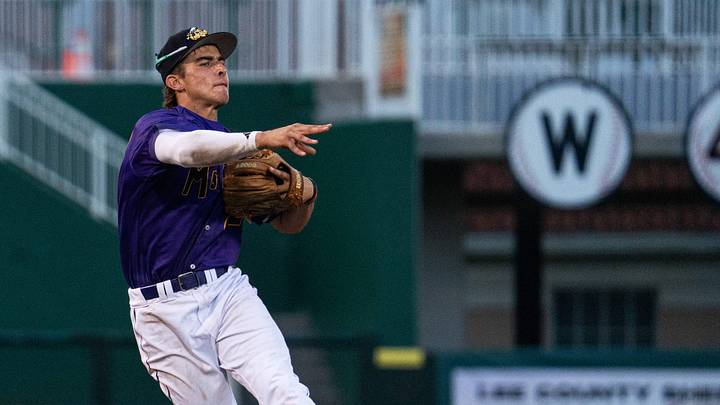
Twins shortstop prospect Marek Houston went into the 2026 season as the Twins' eighth-best prospect on MLB Pipeline, but after what he's done so far in High-A with the Cedar Rapids Kernels, it feels safe to say he should be rising up that list when the midseason update comes out. The Twins selected Houston with their first selection, which was the 16th overall pick in the 2025 MLB Draft. The now 22-year-old was selected out of Wake Forest, which was where he spent all three of his collegiate seasons. In his junior season, Houston hit .354 with 15 homers, good enough for an OPS of 1.055. He also had 15 stolen bases in his 61 games played.
The main concern that scouts had with Houston going into the MLB draft process was his power ability. Despite the 15 home runs he hit during his final college season, scouts gave him a power grade of just 45. Which, if you're unfamiliar with MLB's 20-80 scouting grades, 45 is a below-average grade. Houston's hit tool also graded out on the lower side compared to some of the shortstops that went ahead of him. Scouts gave him a 50-grade hit tool, which is average. The reason that Houston was ranked as a top 15 prospect on MLB Pipeline's 2025 MLB Draft prospect rankings was primarily because of his fielding and partially because of his speed on the bases. His MLB Pipeline scouting report summary labeled Houston as "arguably the best defensive shortstop in the draft." His 60-grade fielding was better than both Eli Willits, who went first overall to the Nationals, and Ethan Holiday, who went fourth overall to the Rockies. Both were viewed as elite high-school shortstop prospects.
After the Twins drafted Houston out of Wake Forest, he would play the first 12 games of his minor league career in Low-A with the Mighty Mussels. He got off to a good start to his professional career in Fort Myers, batting .370 with an .868 OPS. This led to a quick promotion to High-A Cedar Rapids, where he would spend the remainder of the season. In 12 games there, Houston did struggle, batting just .152 with a .459 OPS in what was definitely a small sample size.
For the 2026 season, Houston would begin at High-A, which is where he's spent the entire season up until this point. However, a promotion could be on the horizon, as his overall numbers have been much better than his numbers there last season, and he's really been seeing the ball well as of late. In 53 games in Cedar Rapids this season, Houston is hitting .324 with a .397 OBP and a .854 OPS. He's also been a big threat on the basepaths with 20 stolen bases. The power numbers aren't incredible with just five homers, but the contact ability has been far better than most scouts were expecting him to show, along with elite speed and elite defense. Houston also had his best game of the season on June 13th with a five-hit performance against the Lansing Lugnuts.
To make this pick look like an even bigger win for the Twins, Houston has also seemingly outperformed all of the college shortstops who were drafted around him. With the 7th pick in the draft, the Marlins went with Oregon State shortstop Aiva Arquette, who was looked at as the top college shortstop in the draft class. Arquette is viewed as a worse prospect defensively, but his bat was supposed to be far superior. He is already in Double-A in the Marlins system after starting in High-A, but he's been a below-average hitter with a .647 OPS. In High-A, Arquette's offensive numbers were about the same as what we've seen from Houston. Both have an OPS around .850 at the same level. Houston has been more of a threat on the basepaths with 13 more stolen bases on the season. The difference between these two in prospect rankings is quite vast, with Houston being ranked outside the top 100 on MLB Pipeline and Arquette being slotted in at 32nd.
Houston is one of many promising young infielders in Twins' system
As for where Houston could slot in for the Twins' future plans, that's a big question mark right now. At the minor league level at the shortstop position, the Twins already have their 2024 first-round pick, Kaelen Culpepper, knocking on the door of the major leagues after he's performed very well at Triple-A this season. Two other minor league infielders that are at least worth a mention are Twins shortstop prospects, Brandon Winokur and Kyle DeBarge. Both rank as top 20 prospects in the Twins' system currently, but do rank behind Houston. Winokur was the Twins' third-round pick in 2023 out of high school, and he is one of Houston's teammates right now at High-A. Winokur is a little bit younger and hasn't performed quite as well, though. DeBarge is one level ahead of Houston, as he's spent the entire season at Double-A Wichita. The Twins took him 34th overall in the 2024 draft. DeBarge has struggled to get the bat going, but his elite speed and defense are certainly intriguing. He has 100 career stolen bases in 203 minor league games. With DeBarge's smaller frame, it seems plausible that he could be a second baseman if he reaches the big leagues.
The Twins also have two younger infielders at the major league level who they certainly think could be a big part of their future plans. That being Luke Keaschall and Brooks Lee. Keaschall is 23, and Lee is 25, and both players still have tons of team control remaining, as they are both still in pre-arbitration. Additionally, the Twins still have Royce Lewis under team control for two more seasons after this one. Lewis did just turn 27, so he's starting to not be referred to as a young player much anymore. However, it's definitely a mystery as to where the Twins plan to play him going forward. Personally, I like his odds to stick at first base, given the types of athletic players the Twins seem to like to bring in to play first and their limited depth at the position right now in the system. If the Twins keep Lee, Keaschall, and Lewis as three-fourths of their infield for the long haul, it will get very interesting to see which one of Culpepper or Houston becomes the team's shortstop of the future.
The only way this situation gets even more interesting is if the Twins take another shortstop in this year's MLB draft, where they hold the third overall selection. UCLA shortstop prospect Roch Cholowsky is viewed as the top player in his year's draft class, but it might not be as unanimous as some had thought a few months ago. Cholowsky still had a great season, but he did take a small step back from his sophomore season for the Bruins. Two candidates have been mentioned as possible alternatives for the White Sox, who hold the number one overall selection. That would be high school shortstop prospect Grady Emerson, who has drawn comparisons to Bobby Witt Jr., and Georgia Tech catcher Vahn Lackey, who had one of the best seasons by a catcher in college baseball history. If Cholowsky falls to the Twins at third overall, it would likely be too hard for them to pass up on him, considering his upside. This would make the Twins' system extremely crowded at the shortstop position.
Houston entered the season as a defense-first prospect with questions surrounding his bat, but he's done a lot to quiet those concerns in 2026. His combination of contact ability, speed, and elite defense has turned him into one of the most intriguing prospects in the Twins organization. With several talented infielders already in the system, Minnesota will eventually have some difficult decisions to make about what its infield looks like long-term. For now, though, Houston's emergence is a good problem to have. If he continues producing at this level and earns a promotion to Double-A, he could soon find himself climbing prospect rankings and becoming a legitimate candidate to be the Twins' shortstop of the future.
 Add us as a preferred source on Google