

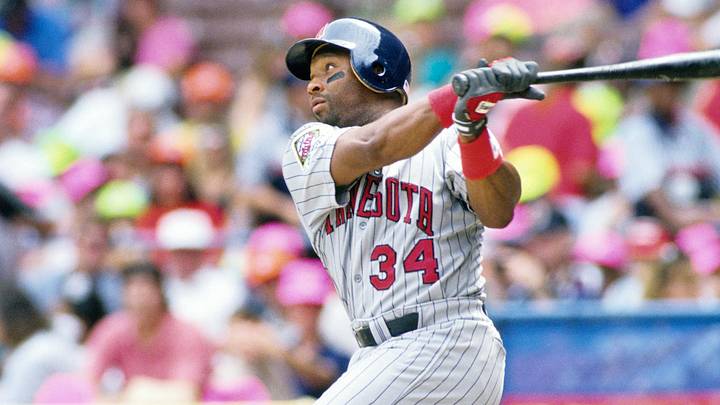
The Silver Slugger Award has only existed since 1980, honoring the best offensive player at each position in both leagues. Winners are selected by MLB managers and coaches, who consider offensive statistics and a player's overall offensive value and cannot vote for players on their own teams. That positional component is important. A Silver Slugger isn't simply one of the best hitters in the league; he's being judged against the other players at his position.
The Twins franchise, of course, goes back much further than 1980. Before moving to Minnesota in 1961, the club played as the Washington Senators, giving us another six decades of hitters who never had a chance to win the award.
So, for those earlier decades, we'll work backward: Which Senators or Twins hitter produced a season that could reasonably have won an American League Silver Slugger at his position? Then, from 1980 on, who was the best actual Silver Slugger winner in Twins Territory in each decade? And because some decades produced more than one worthy candidate, we'll include a runner-up as well.
Let's dig in.
The best Twins Louisville Silver Slugger season of every decade
1920s: Goose Goslin - 1928
Goose Goslin would have looked pretty good holding a Silver Slugger.
The Hall of Fame outfielder hit .379/.442/.614 for Washington in 1928, finishing with a 1.056 OPS, 17 home runs, 36 doubles, and 102 RBI in 135 games. His 176 OPS+ was easily the best of his career. The positional argument holds up, too. Babe Ruth was obviously taking one of three hypothetical American League outfield Silver Sluggers, but Goslin's 1.056 OPS topped fellow AL outfield stars Heinie Manush and Al Simmons.
Even in an era loaded with legendary hitters, Goslin had a Silver Slugger-worthy bat.
1930s: Joe Cronin - 1930
Now imagine these numbers coming from a shortstop...
Joe Cronin hit .346/.422/.513 in 1930, collecting 203 hits, 41 doubles, 127 runs, and 126 RBI. He finished with a .934 OPS and 8.5 WAR while playing all 154 games at shortstop. His performance was good enough to earn him the 1930 American League MVP in contemporary postseason voting, although that year's award is considered unofficial by modern MLB records.
Cronin's offensive production would have been impressive regardless of position. Coming from shortstop, it becomes almost absurd. Had the Silver Slugger existed in 1930, this one wouldn't have required much, if any, debate.
1940s: Cecil Travis - 1941
Ted Williams hit .406 in 1941. Joe DiMaggio had his 56-game hitting streak. And somehow, Cecil Travis led the majors with 218 hits.
Washington's shortstop hit .359/.410/.520 with 39 doubles, an incredible 19 triples, 101 RBI, and 106 runs. His .930 OPS produced a 150 OPS+, and only Williams finished with a better batting average among American League players. Travis played 136 games at shortstop, where his offensive advantage was enormous. Yankees shortstop Phil Rizzuto, for example, hit .307/.343/.398 that season. His career was then interrupted by World War II. Travis spent the next three seasons, 1942 through 1944, serving in the U.S. Army before returning to Washington late in the 1945 season.
Give out Silver Sluggers in 1941, and Travis has an awfully strong claim to one.
1950s: Roy Sievers - 1957
Roy Sievers didn't have the benefit of playing for a powerhouse. The 1957 Senators lost 99 games. He could certainly hit, though.
Sievers blasted an AL-leading 42 home runs with 114 RBI (also tops in the American League) while batting .301/.388/.579. His .967 OPS produced a 164 OPS+, and he finished third in American League MVP voting.
His competition for a hypothetical outfield Silver Slugger was absurd in 1957. Mickey Mantle was still Mickey Mantle, and Ted Williams—at age 38 and 16 years removed from his .406 season—hit .388 with a .526 on-base percentage. Williams and Mantle would have been formidable choices for two of the three outfield spots. But with 42 home runs and a .967 OPS, Sievers had an excellent case for the third.
1960s: Harmon Killebrew - 1969
Some of these require a bit of speculation. This one doesn't require much.
Harmon Killebrew played all 162 games in 1969 and hit 49 home runs with 140 RBI and a staggering 145 walks. He reached base at a .427 clip, slugged .584, and finished with a 1.011 OPS and 177 OPS+. He also won the American League MVP.
Killebrew split his defensive work between third and first base, with third as his primary position. Even there, Oakland's Sal Bando (who also played in all 162 games that year) couldn't match Killebrew's offensive production.
Killebrew was getting a Silver Slugger, without a doubt.
1970s: Rod Carew - 1977
Rod Carew's 1977 season remains one of the greatest offensive performances in franchise history.
Carew hit .388 while producing a .449 on-base percentage and .570 slugging percentage. He collected 239 hits, scored 128 runs, drove in 100, stole 23 bases, and finished with a 1.019 OPS and 178 OPS+. He won the batting title and American League MVP while playing primarily first base.
Had Silver Sluggers existed, Carew probably would have needed to clear some room in the trophy case.
1980s: Kirby Puckett - 1988
Now we arrive at the main event.
Kirby Puckett won four consecutive Silver Sluggers from 1986 through 1989, but his 1988 season stands above the rest. Puckett hit .356/.375/.545 with 234 hits, 42 doubles, 24 home runs and 121 RBI. His .920 OPS produced a 153 OPS+, and he finished third in American League MVP voting. The 234 hits, 121 RBI, and .356 batting average were all career highs.
Runner-up: Kirby Puckett - 1986
Yes, the runner-up is also Puckett. There wasn't much choice, since he was the only Twin to win a Silver Slugger during the decade. His first came in 1986, when he hit .328/.366/.537 with 31 home runs, 223 hits, 119 runs, and 20 stolen bases.
1990s: Kirby Puckett - 1992
No, it isn't a misprint—Kirby Puckett gets two decades. It may not make for the most varied list, but passing him over simply because he already claimed the 1980s would defeat the purpose of picking the best season.
Puckett played 160 games in 1992 and hit .329/.374/.490 with 210 hits, 38 doubles, 19 home runs, 110 RBI and 17 stolen bases. His .864 OPS produced a 139 OPS+, and he finished second in American League MVP voting while winning both the Silver Slugger and Gold Glove. Chuck Knoblauch has a legitimate argument, but Puckett's combination of production, durability, and overall value gives him the edge—and makes him the only player on this list to claim two decades. Quite the testament to the consistency of his career.
Runner-up: Chuck Knoblauch, 1995
Knoblauch's 1995 season certainly doesn't make this an easy decision. The second baseman hit .333/.424/.487 with a .911 OPS, 179 hits, 107 runs, and 46 stolen bases. He finished with a 136 OPS+ and 6.7 WAR while winning his first Silver Slugger. Strangely enough, it wasn't even his best offensive season. In 1996, Knoblauch hit .341/.448/.517 with 197 hits, 140 runs, 45 stolen bases, and a .965 OPS. His OPS+ climbed to 143, and he accumulated 8.7 WAR—but he didn't win the Silver Slugger that year.
Honorable mention: Paul Molitor, 1996
It's hard to discuss Twins Silver Sluggers of the 1990s without room for Paul Molitor. Molitor spent only three seasons with his hometown Twins, but his first was memorable. At age 39, he played 161 games and hit .341/.390/.468 with an American League-leading 225 hits, 41 doubles, 113 RBI and 18 stolen bases. He won the Silver Slugger at designated hitter and collected his 3,000th career hit that September. Puckett and Knoblauch had stronger overall offensive cases for the top two spots, but 225 hits and a .341 average make Molitor far too good to leave out entirely.
2000s: Joe Mauer - 2009
Sorry, Justin Morneau. Joe Mauer's 2009 season is just too difficult to beat.
Mauer missed all of April with inflammation in his right sacroiliac joint and still played 138 games. He hit .365/.444/.587 with 28 home runs, 96 RBI, and a 1.031 OPS, leading the American League in batting average, on-base percentage, and slugging percentage. No catcher in either league had ever led all three categories in the same season. He won the Silver Slugger, Gold Glove, and American League MVP.
The missed time deserves acknowledgment, particularly when compared with the player directly behind him. But 138 games of that level of offensive production is enough.
Runner-up: Justin Morneau, 2006
If durability were the deciding factor, Morneau would have an awfully strong case. Morneau played 157 games in 2006 and hit .321/.375/.559 with 34 home runs, 130 RBI, and 190 hits. His .934 OPS produced a 140 OPS+, and he won both the Silver Slugger and American League MVP. Mauer actually won a Silver Slugger that year, too, hitting .347/.429/.507 and becoming the first American League catcher to win a batting title.
Morneau provided nearly a full season of elite middle-of-the-order production. Mauer's 2009 offensive peak was simply too extraordinary to pass up.
2010s: Nelson Cruz - 2019
Nelson Cruz was 38 when the 2019 season began and turned 39 in July. Apparently nobody told him, or his bat, that.
Cruz played 120 games and hit .311/.392/.639 with 41 home runs, 108 RBI and a career-best 1.031 OPS. His 168 OPS+ was one of the best marks of his career, and he earned the Silver Slugger at designated hitter. He was also the veteran centerpiece of the unforgettable "Bomba Squad," the 2019 Twins team that set a then-MLB record with 307 home runs. Even in a lineup overflowing with power, Cruz was its most dangerous hitter. That gives him the best Twins Silver Slugger season of the decade.
A quick footnote: Mauer won again in 2010 and 2013, and Josh Willingham in 2012, but neither could bring the mix of hitting for average and power that Cruz did...except perhaps the runner-up.
Runner-up: Mitch Garver, 2019
Yes, the two selections come from the same lineup.
Garver hit 31 home runs in just 93 games, slashing .273/.365/.630 with a .995 OPS and 157 OPS+. That's an extraordinary amount of offense from the catcher position, and it earned him his first Silver Slugger. On most Twins teams, that would make him the obvious offensive story of the season. Then again, the 2019 Twins were not most Twins teams.
2020s: Byron Buxton - 2025
While Nelson Cruz has the better rate statistics (see below), Byron Buxton gets the nod for doing it across something resembling a normal season.
Buxton played 126 games in 2025 and hit .264/.327/.551 with 35 home runs, 83 RBI, and 97 runs. He also went a perfect 24-for-24 stealing bases, becoming the second player in Twins history with at least 30 homers and 20 steals in a season. The performance earned Buxton the first Silver Slugger of his career as one of the American League's three outfield winners. With the 2026 awards still to come, and the rest of the decade to follow, he's our pick for the decade so far.
Runner-up: Nelson Cruz, 2020
There is an obvious caveat here: the pandemic-shortened 2020 season consisted of only 60 games. Cruz played 53 of them and hit .303/.397/.595 with 16 home runs, 33 RBI and a .992 OPS. His 171 OPS+ was actually better than his mark from 2019, and he won his second consecutive Silver Slugger with Minnesota.
On pure rate of production, Cruz beats Buxton. When choosing the best season of the decade, though, 126 games of Buxton's power-speed combination gets the slight edge over 53 games in an abbreviated season, as it should.
A century of Silver Slugger-worthy Twins
From Goslin and Cronin in Washington to Puckett, Mauer, Cruz and Buxton in Minnesota, the franchise has never lacked elite hitters. The award itself may only date to 1980, but the kind of offensive seasons it recognizes have been part of Twins and Senators history for far longer.
 Add us as a preferred source on Google