

For the better part of a decade, Byron Buxton has been considered the frontman for the Minnesota Twins.
Through rebuilds, postseason runs, injuries, managerial changes and seemingly endless roster turnover, Buxton remained the constant. When healthy, he could do things few other players in baseball could do. He became an All-Star, one of the game's premier defensive center fielders and ultimately the face of the franchise.
For the first half of 2026, that still felt unquestionably true, but something has changed. And no, this isn't about Walker Jenkins arriving in Minnesota. Jenkins' promotion might make the changing of the guard easier to see, but it didn't start when the Twins announced his call-up. Nor is this an argument that a 21-year-old who hasn't taken a Major League at-bat should suddenly replace Buxton as the face of the franchise. This has been happening for a while.
Buxton has largely disappeared from the story of the Twins' second half, due in no small part to a hip that hasn't allowed him to stay on the field or perform like the player Minnesota watched before the All-Star break. At the same time, the identity of the team around him has begun to change.
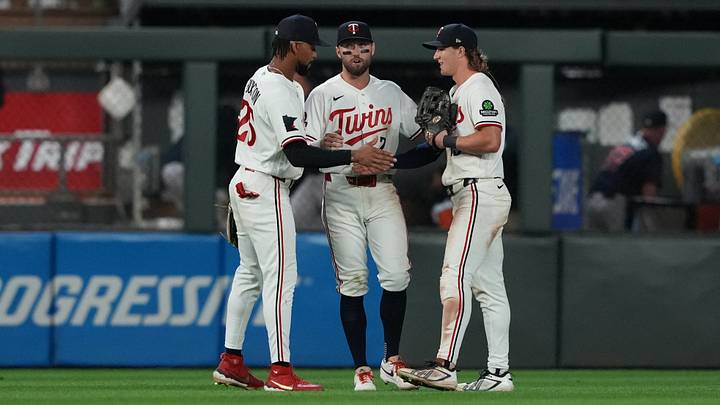
Luke Keaschall is hitting leadoff, Brooks Lee has established himself as an everyday presence in the lineup, and Kody Clemens has repeatedly come through in big spots. Kaelen Culpepper arrived earlier this month and immediately looked like he belonged in the big leagues. Royce Lewis remains part of that picture, too, even if he hasn't emerged as the singular heir apparent to Buxton that once seemed possible. Jenkins is simply the latest piece to arrive.
So this isn't about handing Byron Buxton's team to Walker Jenkins. It's about asking whether Byron Buxton is the face of the franchise anymore.
Byron Buxton isn't driving the Twins right now
This isn't an argument that Buxton is finished. I'm not even remotely suggesting that. It's not a prediction about what kind of player he'll be next season, either. It's a much simpler question: Is Byron Buxton still the driving force behind the Minnesota Twins?
For the first half of 2026, the answer was unquestionably yes. Buxton hit .271/.328/.575 with 25 home runs and 45 RBI in 75 games before the All-Star break. He was elected an All-Star starter, and his .903 first-half OPS was another reminder of just how transformative Buxton can be when everything is working. Then his troublesome right hip took over the story.
The hip has bothered Buxton since May. It kept him from starting the All-Star Game despite being elected by the fans and has already sent him to the injured list twice this season. This week, the same hip forced him from another game after he experienced discomfort while trying cut off a hit in the gap.
Byron Buxton was removed from the game with an injury after reaching down for a ball in the outfield pic.twitter.com/rVZiRD71d4
— Talkin' Baseball (@TalkinBaseball_) August 26, 2026
His production since the break has fallen off just as dramatically. In 18 second-half games, Buxton is hitting just .172/.274/.203. He has 11 hits in 64 at-bats, only two of them for extra bases. He hasn't hit a home run, has driven in just one run, and owns a .477 OPS. Compare that with 25 home runs and a .903 OPS before the break, and it's difficult to argue that Buxton is currently driving this team the way he did during the first half.
The injury context matters because this isn't simply Buxton suddenly forgetting how to hit. He's clearly not the same player Minnesota watched before the break, and there's obviously something awry. Whether it is a nagging injury or a deep slump, the result has been the same: at a time when Minnesota has been desperately trying to stay in the postseason race, its longtime driving force hasn't been able to drive it.
For a while, it seemed obvious who might eventually inherit that mantle. Royce Lewis exploded onto the scene with the kind of postseason performance that made superstardom feel almost inevitable. Some fans will undoubtedly argue that Lewis remains as logical a candidate as anyone to eventually become the face of the Twins. But that transition hasn't really happened, either. Lewis remains an important part of Minnesota's future, but he hasn't emerged as the singular force around which this team revolves. Instead, something more interesting has happened. There may not be one heir to Byron Buxton at all.
The Twins' new identity is emerging by committee
We'll start at the top of the lineup. Derek Shelton gave Keaschall his first opportunity of the season in the leadoff spot on August 17, and he responded by doubling to open the game and adding another single his next time up. Keaschall has extensive experience hitting leadoff from his time in the minors, and Minnesota has continued giving him opportunities at the top. Just a few days later, he hit his first career leadoff home run. There's something almost symbolic about that. Keaschall isn't waiting to become part of the Twins' next core. He's already being asked to set the table for it.
Then there is Brooks Lee. Lee began the season as Minnesota's starting shortstop, but the Twins made a significant change in late May, moving him to third base. The move appears to have helped Lee settle into a role that fits him. He's become an everyday presence at the hot corner while also emerging as a legitimate run producer, surpassing 20 home runs this season with 70 RBI—good for second on the team only to Josh Bell (80). He's increasingly looking less like a former top prospect the Twins are waiting on and more like a player they can build with—one who may have found his long-term home in the process.
Clemens has been an entirely different kind of revelation. He wasn't supposed to be one of the defining players of Minnesota's next era. Instead, he's turned himself into something every good team needs: a super-utility player willing and able to go pretty much wherever the Twins need him. First base, second base, left field, right field. Even center field. Wherever Derek Shelton has needed Clemens, he's answered the call. And he's done more than simply fill holes on the lineup card. Clemens has repeatedly made plays wherever he's been asked to play while providing unexpected production at the plate. He's also come through when Minnesota has needed him.
During the Twins' recent stretch against Atlanta and San Diego, Clemens drove in seven runs on eight hits in just 18 at-bats. His production was pivotal in Minnesota's sweep of the Braves, including the eventual game-winning hit in the series finale. Sometimes a new core includes the players everyone expected. Sometimes it includes the guy who's willing to go wherever he's needed—and keeps coming through.
Kaelen Culpepper falls firmly into that first category. The 2024 first-round pick arrived with expectations attached, but he has wasted little time showing why. Since making his Major League debut on August 7, Culpepper has immediately looked comfortable against Major League pitching. Through his first 16 games, he's hitting .333 with three home runs. He's another former top prospect who isn't waiting around to become part of the Twins' future. He's already becoming part of their present.
And then there's Jenkins. Minnesota's top prospect is finally in the Major Leagues. MLB Pipeline ranks him No. 15 among all prospects in baseball, and the 21-year-old forced the issue with an extraordinary August at Triple-A St. Paul, hitting .411 with a .488 on-base percentage and eight home runs in 18 games. Again, that doesn't suddenly make the Twins Jenkins' team. He hasn't taken a Major League at-bat yet. His arrival matters because he's another piece of something that was already taking shape.
If the identity of the Twins is changing, it isn't because one player has stepped forward and claimed Buxton's place. It's happening by committee in real time. That's what makes this feel less like the arrival of a few promising young players and more like the beginning of a genuine transition.
The changing of the guard might eventually become literal
Perhaps the most interesting symbol of this transition is the position Buxton has owned since he arrived in Minnesota—center field.
There's already speculation about whether the Twins should eventually move Buxton to a corner outfield position, particularly with Jenkins now reaching the Major Leagues. The question isn't necessarily whether Buxton can still play center field. It's whether he should.
Center field asks a lot of a player's body, and Buxton's body has repeatedly struggled to withstand that demand. His current hip problem has bothered him since May and has already led to multiple trips to the injured list this season. His latest aggravation hasn't resulted in another trip to the IL yet, but Jenkins' arrival gives the Twins another option if Buxton needs additional time to recover.
Jenkins suddenly gives Minnesota something it hasn't really had throughout most of Buxton's career: a legitimate potential long-term alternative in center. That doesn't mean Minnesota needs to hand Jenkins center field tomorrow. It doesn't mean Buxton is incapable of playing the position anymore, either. But perhaps the position and the player don't have to remain inseparable forever.
Anyone ever heard of Mike Trout, Ken Griffey Jr., or Kirby Puckett?
Moving an aging star out of center field isn't a demotion. Sometimes it's simply an acknowledgment that one of baseball's most demanding positions doesn't have to be a permanent assignment. For Buxton, a move to a corner could eventually be less about replacing him and more about reducing the physical burden on his body.
A changing of the guard doesn't require pushing Byron Buxton aside. Buxton can still be enormously important to the Minnesota Twins. A healthy Buxton can still change games. He can still be a leader in a clubhouse increasingly populated by players who grew up watching him play. But being an important part of the team isn't necessarily the same thing as it being your team.
For years, the Twins' identity seemed inseparable from one question: What could this team be if Byron Buxton could just stay healthy? Maybe they're finally building a team that doesn't require an answer. This isn't about finding the next player to call the face of the franchise. It's about recognizing that the Twins are increasingly being driven by a group rather than one defining star.
The new guard isn't one player—it's already here.
 Add us as a preferred source on Google