

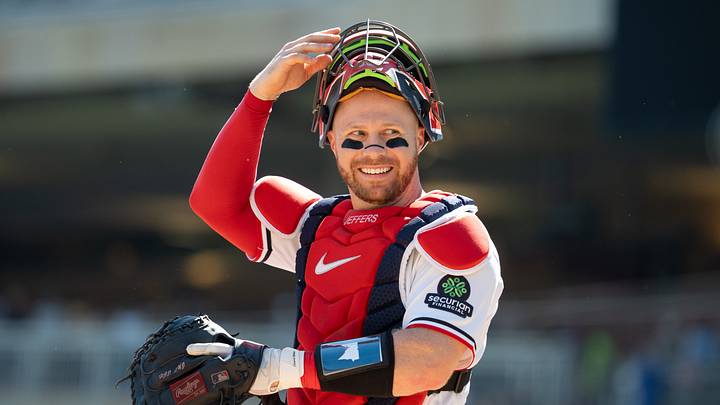
The Twins made a tough decision at the trade deadline this season when they elected to hold on to Ryan Jeffers instead of trading him for what likely would have been a valuable return. The Twins' decision to hold onto their rentals while adding to the pitching staff at the trade deadline is something the front office is surely regretting now, given that they were just eliminated from playoff contention with six games still left to play in their season.
Ryan Jeffers is one of the first players that comes to mind when considering who the Twins would have been most likely to ship off at the trade deadline in early August. Despite the fact that the Twins were still in the playoff mix, they had been under .500 for most of the season and trailed the White Sox by several games in the American League Central Division. There were several contenders that had interest in Jeffers at the time, given the fact that he was in the middle of the best offensive season of his career by a long shot. He's currently in his age-29 season and is set to be a free agent for the first time in his career.
Despite Jeffers' .145 batting average and .540 OPS so far in September, he's still having a career season. He got off to an incredible start to the season and was arguably the Twins' best player before fracturing his hamate bone on May 18th, an injury that kept him out for nearly two months. He posted a .927 OPS in March and April, followed by a .993 OPS in May before the injury. Unfortunately for Jeffers and the Twins, his first-half performance was vastly better than his second-half performance this year. In 39 games before the All-Star break this season, he batted .292 with seven homers and a .940 OPS. In 50 games since the break, he's batted .222, hit seven homers, and had a .713 OPS. He's still posted very solid overall offensive numbers this season, especially for a catcher, slashing .252/.351/.461.
At the time of the trade deadline, Jeffers was on pace to be a surefire candidate to receive the qualifying offer. The number hasn't been set yet for this season, but it's decided based on the mean salary of the 125 highest-paid players in the league. After a strugglesome month of September, it's surely given the Twins more of a reason not to extend him the QO. Last offseason, the qualifying offer was extended to thirteen players, four of which accepted it. Those four were Trent Grisham (Yankees), Gleyber Torres (Tigers), Brandon Woodruff (Brewers), and Shota Imanaga (Cubs). The last player the Twins extended the qualifying offer to was Sonny Gray after the 2023 season. He declined it and landed a multi-year deal with the Cardinals.
One of the biggest reasons why the Twins likely elected to hang on to Ryan Jeffers at the trade deadline was due to the fact that Jeffers had never received a qualifying offer previously and would be with the team for the entire season. This means that if Jeffers was offered the qualifying offer and rejected it and then signed with any of the other 29 teams, the Twins would receive a fairly high compensation pick in the draft. If this scenario does happen (which seems very possible at this point) and Jeffers signs with another team for a contract worth over $50 million (doesn't matter the number of years), the Twins would receive a pick in Competitive Balance Round A, which would likely be a pick in the mid-30s. If Jeffers signs with another team this offseason for a contract worth under $50 million, then that pick would be in Competitive Balance Round B, which would likely be in the high-60s. The Twins will have five days after the conclusion of the World Series to decide whether or not they'll want to give Jeffers the QO. If they do decide to offer, he will have 10 days after receiving the offer to decide whether or not to accept it.
Twins need Ryan Jeffers back in 2027
Now, how badly do the Twins need Jeffers back this season? In my opinion, very badly. It's hard to tell where they'll turn for the starting catcher position next year without bringing Jeffers back. The only other catcher they have on the 40-man roster is Victor Caratini, who has performed rather poorly this season at the plate, especially since the All-Star break, batting .176 with a .449 OPS. The defense has been fine, and he's been really good with the ABS. With the $7 million salary that Caratini is due next year, it's safe to say that he'll at least have a backup role with the Twins in 2027. If Jeffers isn't back next season, the Twins will need another starting catcher to pair with Caratini, and the free agent class for catchers this offseason is nothing to write home about. The top three upcoming unrestricted free-agent catchers by bWAR, not including Jeffers, are Tyler Stephenson (2.5), Austin Hedges (0.8), and old friend Christian Vazquez (0.4). Therefore, there's really only one quality starting catcher available on the free-agent market other than Jeffers.
If Jeffers does want a multi-year deal in free agency, you can definitely make the argument that the Twins should either go hard after Stephenson or pivot to the trade market. This is due to the fact that they just drafted their catcher of the future, Vahn Lackey, out of Georgia Tech with the third overall selection in the 2026 MLB Draft. He had an encouraging first 25 games to start his professional career, playing 15 games in Low-A and 10 games in High-A. Lackey slashed .250/.435/.424 between the two levels with three homers, driving in 16 runs and six caught stealing behind the dish. The Twins having one of the best catching prospects in baseball shouldn't have any impact on them offering Jeffers the QO. This is due to the fact that Lackey likely won't reach the majors until at least the 2028 season, maybe late 2027 at the earliest if he tears it up in the minor leagues next season. However, if Jeffers is seeking a multi-year deal on the open market, it seems plausible to think that the Twins likely wouldn't be one of the top candidates to sign him.
Overall, the Twins will have a difficult decision to make with Jeffers this offseason. In my eyes, the only way that Jeffers returns to Minnesota is if they do extend him the QO and he decides to accept it, which, as of now, does seem like a possibility. Despite his second-half struggles, he has still put together one of the best seasons of his career and remains one of the better offensive catchers in baseball. With a weak free-agent catching class and Vahn Lackey likely still a couple of years away from reaching the majors, replacing Jeffers wouldn't be easy. Whether the Twins bring him back or allow him to walk in free agency, extending him the qualifying offer will be one of the biggest decisions they make this offseason.
 Add us as a preferred source on Google