

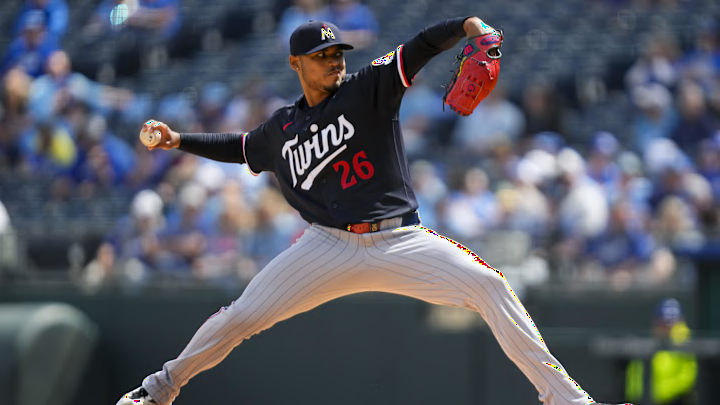
A couple of weeks into the season, numbers are just beginning to settle into something meaningful. It’s still early—but not so early that everything can be dismissed as noise. For the Twins, that early snapshot already tells a mixed story. There are encouraging signs, a few concerning ones, and at least one name quietly working his way into the conversation.
Examining the Twins' early highs, lows, and one name to watch
The Highs
Bell providing much-needed stability.
2026 Stats (12 games): .270 AVG | .404 OBP | .541 SLG | 2 HR | 9 RBI
Through the opening stretch, Josh Bell has delivered exactly what the Twins brought him in to do—a steady, productive presence in the middle of the lineup as the team's primary designated hitter. The results have been there, but just as importantly, so has the consistency. At a time when other parts of the lineup are still finding their footing, Bell's early production has helped keep things from stalling out entirely.
Jeffers gaining an edge with ABS challenges.
2026 ABS Stats: 15 challenges | 10 won | 67% won | 8 +K Flip
Ryan Jeffers’ impact hasn’t been limited to the batter’s box. Early on, he’s been one of the more effective users of the ABS challenge system, turning borderline calls into tangible advantages. For example, 8 of Jeffers' 10 wins have changed a ball into a strikeout. It’s a subtle part of the game, but one that can shift at-bats and innings—and so far, it’s working in the Twins’ favor.
Bradley's hot start.
2026 Stats (3 starts): 2-0 | 1.08 ERA | 1.08 WHIP | 22 K (Top 5 MLB)
Through his first three starts, and most recently when he outdueled Tigers ace Tarik Skubal, Taj Bradley has already placed himself among the league leaders in strikeouts. The swing-and-miss ability is translating immediately, and it’s giving the Twins something they’ve needed: a pitcher capable of controlling at-bats without relying on contact. If that trend holds, it changes the ceiling of the rotation in a meaningful way.
The Lows
Wallner's strikeout problem.
2026 Stats (12 games): .224 AVG | .269 OBP | .449 SLG | 3 HR | 5 RBI
Matt Wallner’s power remains evident, but so does the rate at which he swings and misses. Through 52 plate appearances, Wallner is currently leading MLB in strikeouts (now four ahead of Cal Raleigh) with 25 while simultaneously leading the Twins in hits and home runs. Clearly, the balance isn't there at the moment but if Wallner remains on this pace, a roughly 48% strikeout rate, it projects to over 240 strikeouts across a full season of qualifying plate appearances—an unsustainable number if the Twins want his power to consistently play.
Buxton and Lewis searching for rhythm.
Buxton 2026 Stats (11 games): .214 AVG | .292 OBP | .333 SLG | 0 HR | 1 RBI | 11 SO
Lewis 2026 Stats (11 games): .219 AVG | .390 OBP | .469 SLG | 2 HR | 8 RBI | 11 SO
For two players viewed as foundational pieces, the early returns have been uneven. Both Buxton and Lewis currently have more strikeouts than hits—a shocking statistic for both players. It's not about drawing conclusions this early, but it is about recognizing patterns. When the players that are expected to carry the lineup are struggling to put the ball in play consistently, and therefore not generating or driving in runs, it's never too early to start raising the red flag. The Twins need both Buxton and Lewis to contribute; right now, neither is on a consistent basis.
The Surprise - Tristian Gray
Gray 2026 Stats (5 games): .286 AVG | .353 OBP | .571 SLG | 1 HR | 8 RBI | .924 OPS
Lee 2026 Stats (10 games): .167 AVG | .219 OBP | .167 SLG | 0 HR | 2 RBI | .385 OPS
Gray’s early production stands out even more when you look at it next to starting shortstop Brooks Lee. Lee came into the season with a clear role and higher expectations, but the results just haven’t been there yet. The at-bats haven’t been as consistent, and the production hasn’t followed, and there have been some defensive issues mixed in as well. That doesn’t change the long-term view of Lee, but it does matter right now.
At the same time, Gray is doing exactly what the Twins have been looking for—putting together competitive at-bats, playing clean defense, and finding ways to contribute when given the opportunity. If that keeps up, he’s going to force his way into a bigger role sooner rather than later.
What It Means
Early in the season, it’s easy to separate results from reality—but the two don’t stay separate for long. The Twins are already seeing signs of both stability and concern, often in equal measure. Bell’s consistency, Jeffers’ awareness, and Bradley’s strikeout ability offer reasons for optimism. At the same time, strikeout-heavy trends from key hitters and uneven production from expected cornerstones raise legitimate questions. Gray’s emergence only adds another layer to that picture. It’s still early—but not so early that these trends can be ignored.
 Add us as a preferred source on Google