

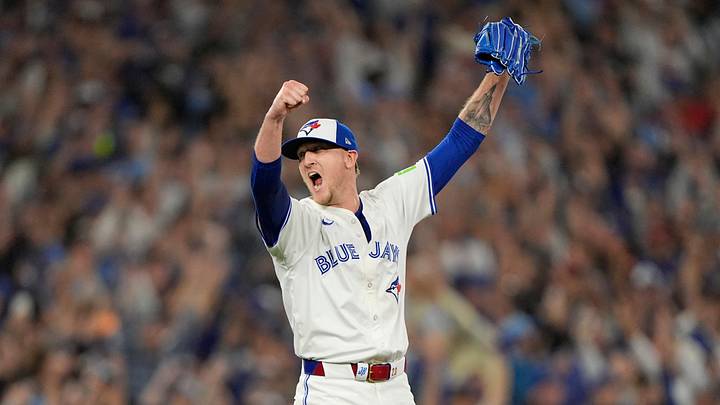
The Minnesota Twins addressed their biggest needs at the trade deadline. General manager Jeremy Zoll didn't make any moves that would be considered "blockbuster deals," but he improved the Twins' roster without surrendering too much value. Granted, the Jeff Hoffman trade included a top-10 organizational prospect, but we will dive into why the Twins were okay with parting ways with said minor leaguer.
Grading Twins' trade deadline after Tom Pohlad gave Jerermy Zoll green light to buy
July 10: Twins acquire right-handed reliever Tommy Nance from Toronto Blue Jays for catcher/infield prospect Ryan Sprock. GRADE: B.
Nance, 35, isn't a game-changer by any means, but he improves the Twins' bullpen, which ranks 26th in ERA (4.95). In 7 2/3 innings across eight appearances since joining Minnesota, Nance has posted a strong 2.35 ERA with eight strikeouts.
Sprock is a solid prospect, but he isn't among Toronto's top-30 prospects according to MLB Pipeline. The odds of him becoming an everyday major leaguer are low, so moving him for Nance, who will hit arbitration for the first time next year, seems like a solid move. The only reason I give this a "B" and not an "A" is because Nance is decent, not elite.
July 31: Twins acquire left-handed reliever A.J. Minter from New York Mets for infield prospects Billy Amick, Bruin Agbayani. Grade A.
I went ahead and gave this trade an "A" grade because Minter has been very good since returning from the IL in May, posting a 2.35 ERA with a 1.00 WHIP and 20 strikeouts over 23 innings.
Minter is only under team control through this season, but Amick and Agbayani both ranked outside the Twins' top-20 prospects. Minter has 10 years of big-league experience and has pitched in a World Series. He has a career 3.16 ERA in 384 innings. To acquire a reliever who will slot into the back end of the bullpen for two lower-ranked prospects is a great move for Minnesota.
Aug. 1: Twins acquire right-handed starting pitcher Dean Kremer from Baltimore Orioles for outfield prospect Jhomnardo Reyes. Grade B-.
The Twins needed to add another starting pitcher. After Joe Ryan, Taj Bradley, Bailey Ober, Connor Prielipp and Zebby Matthews, the Twins didn't have much rotation depth before acquiring Kremer, who will make his first start as a Twin against the Kansas City Royals on Wednesday night. Minnesota optioned Matthews to Triple-A to make room for Kremer in the rotation.
While Zoll addressed a need by adding Kremer, the right-hander isn't the most exciting addition for Minnesota. Baltimore placed Kremer on the injured list with a right quad strain after he made just two starts this year. Since he returned on July 1, Kremer has recorded a 7.56 ERA in 25 innings over five starts.
It seems unfair to judge Kremer based on his July stats from this season. However, his numbers from past seasons aren't amazing, either. He had an outstanding 2022 season, posting a 3.23 ERA in 125 1/3 innings, but he posted an ERA north of 4.00 in each of the following three seasons. Last year, he posted 2.2 bWAR and a 4.19 ERA with 142 strikeouts over 171 1/3 innings. Basically, it seems that the best version of Kremer is comparable to the Simeon Woods Richardson we saw the last two seasons.
Reyes is just 18 years old, so it's difficult to predict how he will pan out later in his career. He just recently earned a promotion to Single-A, and collected just two hits in 21 at-bats for Fort Myers. Before that, he slashed an outstanding .296/.409/.541 with seven home runs, 44 RBI and 14 stolen bases over 49 games in rookie ball.
I had a difficult time grading this trade. I like that Zoll acquired a starting pitcher, but it would've been more exciting to see the team add a rental like Kevin Gausman instead. Kremer being under team control through 2027 is a nice factor of the deal, but his July struggles, his mediocre stats over the last several years and his low strikeout rate make this deal seem underwhelming. Giving up a lower-ranked 18-year-old prospect isn't a terrible move, but Reyes' .950 OPS in rookie ball this year proves he has the potential to be a solid everyday big leaguer one day, even if it's unlikely.
Aug. 3: Twins acquire Jeff Hoffman from Toronto Blue Jays for left-hander Dasan Hill (Now Toronto's No. 6 prospect), right-hander John Klein (Blue Jays' No. 25), infielder Dameury Pena. Grade B+.
This move was easily the Twins' biggest splash of the deadline. Hoffman is an elite late-inning arm at his best. The right-hander had a rough 6.31 ERA through 25 2/3 innings to begin the year, but has since recorded a 1.21 ERA with 30 strikeouts in 22 1/3 innings.
Hoffman is under team control through 2027. According to Dan Hayes of The Athletic, the Twins are taking on the remainder of Hoffman's 2026 salary, and Toronto is paying a portion of his 2027 salary.
Source: #MNTwins are taking on the remainder of Jeff Hoffman's 2026 salary, but Blue Jays are paying a portion of his 2027 salary.
— DanHayesMLB (@DanHayesMLB) August 3, 2026
The Twins will pay Hoffman roughly $3.24 million this year. He is set to make $11 million next season, and the Twins will pay $7.25 million of that, according to Spotrac.
There is some concern that comes with Hoffman. The right-hander began the year as the Blue Jays' closer before losing the role to former Twin Louis Varland. Last season, he allowed a .749 OPS in 135 high-leverage plate appearances and a .590 OPS over 56 medium-leverage plate appearances. Famously, Hoffman allowed a game-tying home run to Miguel Rojas of the Los Angeles Dodgers in the ninth inning of World Series Game 7 last year.
Regardless, Hoffman is still a late-inning arm, which the Twins desperately needed. This season, he has an elite chase rate of 38.1%, a whiff rate of 37.8% and a strikeout rate of 34.9%.
The only reason I give this trade a B+ and not an A is that the Twins gave up a promising pitching prospect in Dasan Hill to land Hoffman. Hill, 20, has an electric fastball that touches 100 mph. He complements his heater with a 60-grade slider, a 55-grade curveball and a 50-grade changeup. However, Hill has a 5.80 ERA with 37 walks in 45 innings for High-A Cedar Rapids this year. His command issues are likely why Minnesota felt fine parting ways with the southpaw to improve the active roster.
 Add us as a preferred source on Google