

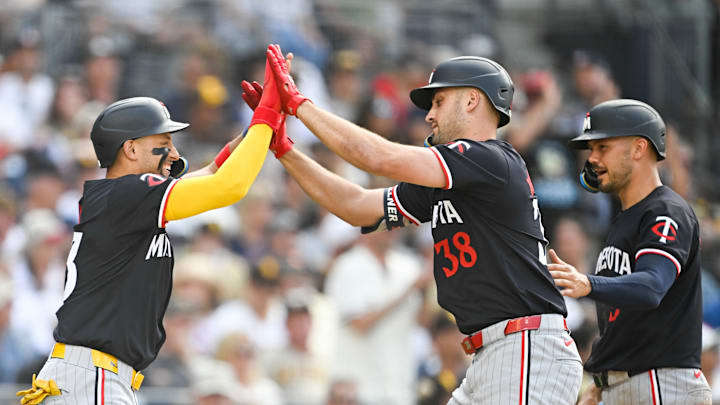
The Minnesota Twins have spent the recent years walking a precariously fine line: attempting to balance upside with uncertainty. We know the club has talent; we've seen the proof coming up through the ranks, but unfortunately, there are some glaring question marks among the Twins' everyday position players. For an organization navigating self-imposed payroll limitations and an ever-shrinking margin for error, unanswered questions are liabilities.
For Royce Lewis, Trevor Larnach, and Matt Wallner, 2026 figures to be a make-or-break season for each one of them. For all the talent each one of them brings to the table, each of these players is running out of time to show that Minnesota is where they belong - and that the Twins even need them at all. Each faces a different test this year, but all need to make a statement - and in a hurry.
Make It or Break It: Three Twins at a Crossroads in 2026
1. Royce Lewis - Availability

There is no longer any debate about Royce Lewis' ability. When healthy, he is one of the most dynamic players on the roster - providing a middle-of-the-order bat and positional flexibility to boot. His presence in the lineup is the kind that causes opposing pitchers to change how they approach an inning. The problem, of course, is that "when healthy" has become the defining clause of his career.
Lewis's repeated injury setbacks have done more than stall his own development - they've forced the Twins into contingency planning, as they once had to do with Byron Buxton. Lineups and defensive alignments remain fluid with the Twins unable to commit to Lewis as a daily cornerstone, despite his undeniable skill and impact.
Now in 2026, Lewis is no longer a prospect with time on his side. He will turn 27 in June and should be in the prime of his career, not trying to prove he can be trusted to be available. 2026 isn't about proving his star power; we know the skills are there, but rather it is about proving he can remain healthy and on the field. Twins Territory saw what a healthy Buxton could be to the team, and now Lewis finds himself in a similar situation. His team is expecting a rebound season, but only time will tell if he will be a nice bonus in the lineup or a foundational piece going forward.
2. Trevor Larnach - Definition

Trevor Larnach's career arc has been quieter than Lewis's but no less critical. Once viewed as a key piece of the Twins' outfield plans, Larnach now enters 2026 needing something he has yet to attain fully - definition. The raw tools are there, and Larnach has shown the ability to drive the ball, work counts, and contribute offensively - especially against right-handed pitching. What he hasn't shown, at least not for long stretches, is the consistency required of an everyday corner outfielder. The way I'd describe his contributions over the last several seasons is "milquetoast." Not bad, but never consistently "wow" either.
Injuries and uneven usage have played a role, but context only goes so far. In 2026, the Twins will need to decide if Larnach is a regular player or a role player - not some hybrid of inconsistent usage and play time. For Larnach, this season represents a window that seems to be closing. Continued inconsistency risks being put into a platoon situation in the outfield or being considered expendable altogether. A strong and sustained showing could finally cement him as an anchor in the lineup. Larnach has never been considered a liability, but with the flashy talent coming up from the minors, he will need to show why he is the better, long-term choice in a big way.
The Twins likely signaled their confidence in Larnach in November when they tendered him a contract for this year. For Larnach, this only means it's time to put your money where your mouth (talent?) is and prove to be worth the cost.
3. Matt Wallner - Consistency

Of all the players on the Twins' 2025 roster, no player made me cheer or shake my head in disbelief more than Matt Wallner. No Twin embodied extremes like he did last season - and there was no middle ground to be found. At his best, he offers moonshot power, a cannon for an arm, and the ability to change a game with a single swing. At his worst, Wallner is a streaky hitter who is prone to extended slumps, especially against left-handed pitching. Feast or famine! Unfortunately, it has resulted in comparisons to Joey Gallo - not flattering in the least.
The Twins do not need Wallner to reinvent himself in 2026 - they need him to stabilize. It is hard to pinpoint why he has been so erratic in his production. Overall, he has proven that he has the defensive skills to impact a game with his rocket arm and his ability to crush a baseball into powder with his bat. As we know, power plays at the major league level, but without consistency, it becomes difficult to justify an everyday roster spot.
Wallner's climb is the steepest on this list because he had so much ground in between his best and worst forms. Steady production is what the Twins must see from Wallner in 2026 - his ceiling is high, but does it outweigh his low floor? Again, only time will tell.
It's Make-or-Break in 2026 for Three Minnesota Twins
What links Lewis, Larnach, and Wallner is not just age or their pedigree but urgency. The Twins cannot afford to carry unresolved questions indefinitely - particularly as they attempt, however feebly, to remain competitive within the constraints of the current team owners. The 2026 season represents a sorting process. Some players will emerge as reliable pieces to build the organization on. Others may find their roles redefined, reduced, or replaced altogether. For Lewis, Larnach, and Wallner, the stakes are not abstract. They are immediate and tangible. For the Twins, clarity is on the way, but they may not like the answers that come with it.
 Add us as a preferred source on Google